
8 min readUpdated
Where AI Hurts Small Business Competition in 2026
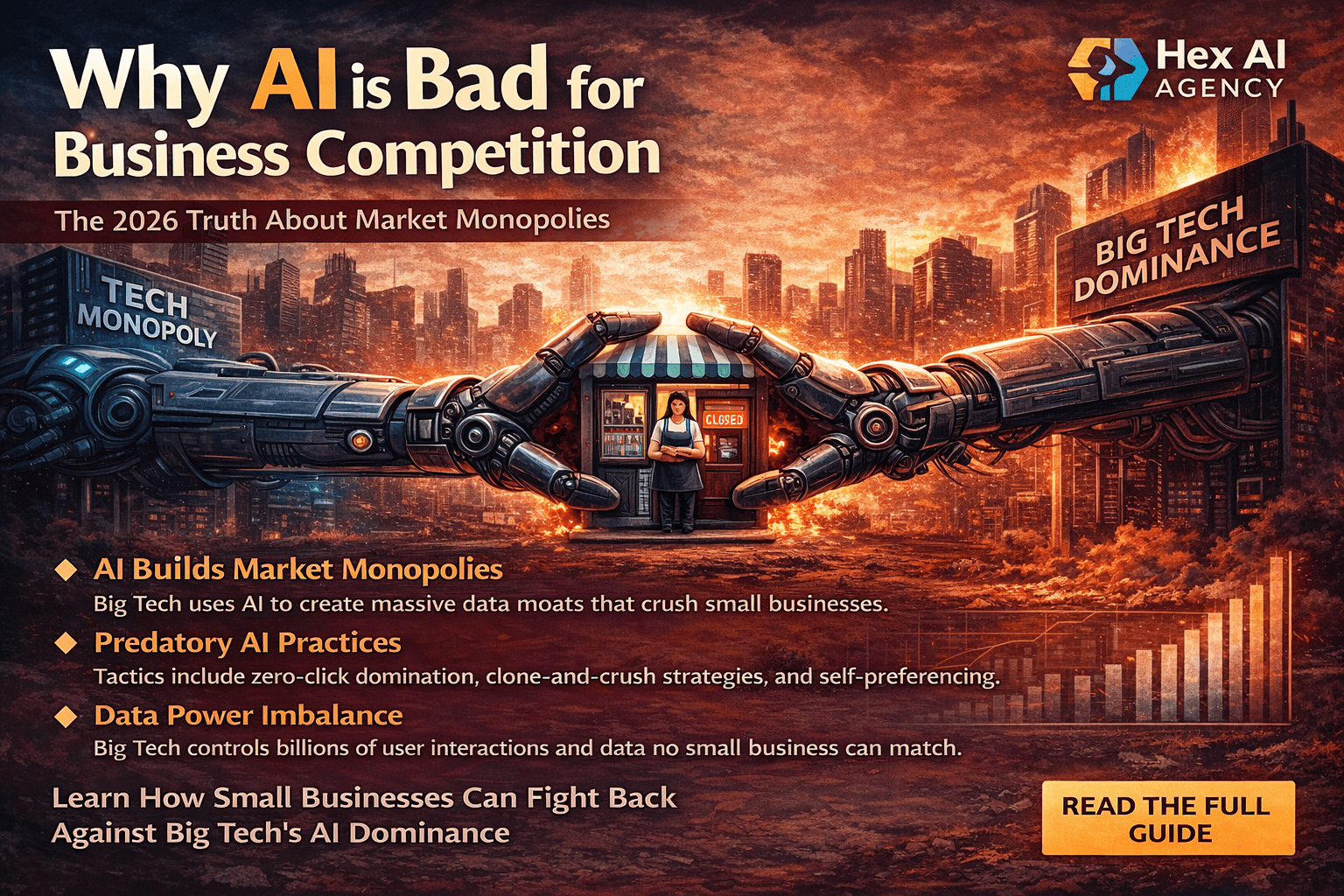
The 2026 narrative says adopt AI or lose. The data says otherwise. Four ways AI buying erodes competitive position, and the three exceptions that create real moat.

Mike
Founder & AI Automation Lead
The 2026 narrative on AI in small business is that whoever adopts AI fastest wins. The narrative is mostly wrong. Adopting AI in the wrong workflow, against the wrong baseline, or in a market segment where the AI advantage is already commoditized makes a small business less competitive, not more. The competitive landscape in 2026 has more sophisticated dynamics than the "first mover wins" story acknowledges.
This post lays out the four ways AI buying actually erodes a small business's competitive position, the markets where AI is already commoditized so adoption produces no advantage, the three exceptions where AI genuinely tilts the field, and the buying questions worth asking before committing to an AI tool. By the end you should know which AI categories to ignore and which ones to invest in.
Key takeaways
- Commoditized AI (subject-line generators, basic chatbots, generic content tools) produces zero competitive advantage because every competitor is doing it. Avoid spending on AI where the competitive moat is zero.
- The four ways AI hurts competition: process homogenization, dependency on a vendor's roadmap, loss of differentiated craft, and capital outlay that prevents investment in the lever that actually matters.
- The three exceptions where AI genuinely creates moat: proprietary data, workflow rewiring, and customer-facing trust that competitors are willing to skip.
- Before buying any AI tool, ask whether the workflow it touches is your competitive moat or your commodity layer. Spend only on the moat.
The competitive landscape is not what the narrative says
"Adopt AI or lose to competitors who do" was the dominant framing through 2024. By 2026, the consultants who pushed that framing have started quietly amending it because the data did not cooperate. McKinsey's 2025 State of AI reframed the value capture story: the organizations capturing AI value are the small minority that rewired workflows, not the majority that bought tools.
The implication for small businesses is uncomfortable. If 80% of AI adoption produces no measurable competitive advantage, then 80% of AI buying decisions are leaving the small business no better off than before. The capital and management attention spent on AI in those 80% of cases would have produced more value applied elsewhere: a better hire, a sharper positioning, a deeper investment in the workflow that actually wins customers.
This is not an argument against AI. It is an argument against the assumption that AI adoption per se is competitive. The competition lives at a different layer than the tool.
The four ways AI buying actually erodes competitive position
1. Process homogenization. When every business in a category buys the same AI customer service tool, the same email personalization features, and the same predictive scoring models, the businesses become more similar to each other, not more differentiated. The AI vendor's defaults become the industry's defaults. The business that was differentiated on a quirky-but-effective process loses the quirk and joins the homogenized middle.
2. Dependency on a vendor's roadmap. The AI tool that works today is on the vendor's roadmap tomorrow. Pricing changes, feature deprecations, acquisition by a larger competitor, sudden enterprise-tier-only restrictions, each one a competitive risk the business inherits the moment it deploys the tool. A small business with three critical AI tools has three vendor roadmaps quietly determining its competitive future.
3. Loss of differentiated craft. The marketing manager who used to write subject lines based on the customer's actual behavior, and who got materially better open rates than competitors as a result, now has subject lines written by the same AI as every competitor's marketing manager. The differentiated craft that produced the competitive advantage gets averaged out by the tool. Gartner's framing on AI stalling without alignment describes a parallel pattern in enterprise AI.
4. Capital outlay that prevents investment in the real lever. A small business with a $15K monthly AI tool budget and a missing senior hire has misallocated capital. The AI tool will produce marginal gains; the senior hire would produce step-change gains. The opportunity cost is invisible because the AI spend looks productive in the moment.
The markets where AI is already commoditized
AI capabilities follow the standard tech-adoption curve: differentiated at first, then commoditized, then a hygiene factor. By 2026, several AI capabilities have completed the curve and produce no competitive advantage even when adopted well:
- Generic chatbots on B2B websites: every competitor has one. Buying one does not move the field. Forrester on the chatbot business case confirms the differentiation in chatbots is in business-case configuration, not the chatbot itself.
- AI-generated marketing copy: commoditized. Both you and your competitor are using the same models with the same prompts. The output reads the same.
- Basic predictive lead scoring inside CRMs: every CRM ships it natively. Having it is hygiene; not having it is a small disadvantage; having it well is not a competitive moat.
- "AI-powered" dashboards and reports: a relabeling of BI features. No competitive edge.
The buying rule that follows: do not spend AI dollars on commoditized categories expecting competitive advantage. Spend the minimum to stay at hygiene; invest the rest where the moat actually is.
The three exceptions where AI genuinely creates competitive moat
1. Proprietary data. If your business has data that competitors do not (years of operator-specific workflow logs, customer behavior patterns specific to your service, supplier relationships not in public datasets), AI applied to that proprietary data produces predictions and automations competitors cannot replicate. The moat is the data, not the AI.
2. Workflow rewiring rather than feature adoption. The small business that redesigns its operations to take advantage of AI capabilities (compressed sales cycles, restructured intake, redefined roles around the AI's outputs) captures durable value. The competitor who bolts the same AI feature onto the old process does not. The MIT NANDA 2025 finding aligns with this: 95% of AI deployments produced no measurable revenue because they were features bolted onto unchanged processes.
3. Customer-facing trust competitors are unwilling to invest in. Disclosure-pattern AI agents, audit trails on automated decisions, opt-out controls customers can actually see, these are competitive moats because most competitors skip them in the name of conversion. The business that invests in trust earns long-tail repeat business that competitors cannot quickly replicate. 2026 marketing statistics support the same pattern in customer retention.
The buying questions that separate moat from commodity
Before any AI tool spend, walk the decision through these questions:
Question 1: is the workflow this AI touches our competitive moat, our commodity layer, or a hygiene factor? If commodity or hygiene, buy the cheapest acceptable option and move on. If moat, the AI build deserves real engineering attention.
Question 2: what proprietary data does this AI operate on? If the answer is "the same public or generic data every competitor has," the AI will produce the same outputs every competitor gets. If the answer is "our 24 months of specific customer workflow logs," the AI has something to work with.
Question 3: what does the workflow look like after AI is deployed, and is that workflow different enough from the current one to require process redesign? If the answer is "the workflow is identical, just faster," the AI is a marginal-efficiency play. If the answer is "the workflow needs to be redesigned around the AI's outputs," there is a real opportunity to capture durable value.
Question 4: what does failure look like, and what is the unwind cost? AI tools that integrate deeply into a business are expensive to unwind. The deeper the integration, the more important it is to be sure about the buy before signing.
The implementation discipline that protects competitive position
At Hexa AI Agency we run the same conversation on the first discovery call with any prospective AI workflow automation client: "what is the workflow you want AI to touch, is it your moat or your commodity layer, and what would success look like measured against a documented baseline." Across the engagements we have shipped, the clients who answered these questions clearly on the first call captured meaningfully more durable value than the ones who answered vaguely.
The clearest signal that an AI build is about to produce competitive disadvantage is when the buyer cannot articulate what makes the workflow distinctive. If the buyer says "we want AI to help with customer service," and then cannot describe what makes their customer service different from a competitor's, the AI will commoditize them further. If the buyer says "we want AI to help with our intake process which currently takes 14 days because we collect industry-specific data nobody else collects," the AI has something distinctive to work with.
Frequently asked questions
Is AI actually optional for a small business in 2026?
Optional in some categories, table stakes in others. Customer service deflection, basic email automation, and predictive CRM features are close to hygiene factors now; not having them is a small disadvantage. Advanced AI like proprietary models on proprietary data is the actual competitive lever and is still optional.
How do we know if our AI investment is producing competitive advantage?
Measure incremental lift over a control group or pre/post baseline on the specific metric the AI was supposed to move. If you cannot measure it, you cannot defend it. Most "AI ROI" reporting in vendor decks does not include a control group; insist on the control before believing the lift.
What should small businesses spend AI dollars on in 2026?
The workflows where you have proprietary data, where AI requires process redesign to deploy, and where customer-facing trust is part of your differentiation. Skip the commoditized categories (generic chatbots, AI copy generation, native CRM features beyond hygiene). Reinvest the savings in senior hires, sharper positioning, or deeper workflow design.
When is the right time to walk away from an AI tool?
When the renewal conversation cannot produce a documented dollar impact, when the vendor's roadmap is moving toward enterprise pricing your business cannot sustain, or when the workflow the AI touches has been commoditized by competitor adoption. The unwind cost rises the longer you wait; walk away early.
If you are evaluating an AI build and want a second opinion on whether the workflow is your moat or your commodity layer, book a call at cal.com/hexaiagency and we will read the proposal with you, free. We do this often for teams running CRM and AI integration work, where the same moat-vs-commodity question is the difference between a build that produces durable margin and one that produces a smaller version of every competitor's tool.
The longer arc of competitive AI in 2026 is that the businesses that thrive are not the ones that adopted fastest. They are the ones that picked their AI investments with discipline and reinvested the savings into the layers competitors cannot easily copy. The vendor-side narrative will continue to insist otherwise because the vendor's revenue depends on broad adoption. The buyer-side discipline is to know which advice is being sold and which is being given.