
8 min readUpdated
Why Tenants Pay Late (and the AI Nudge Sequence That Fixes It)
Most late rent is friction or forgetting, not deliberate non-payment. The five-touch AI nudge sequence that compresses delinquency 30-50% on mid-market portfolios.

Mike
Founder & AI Automation Lead
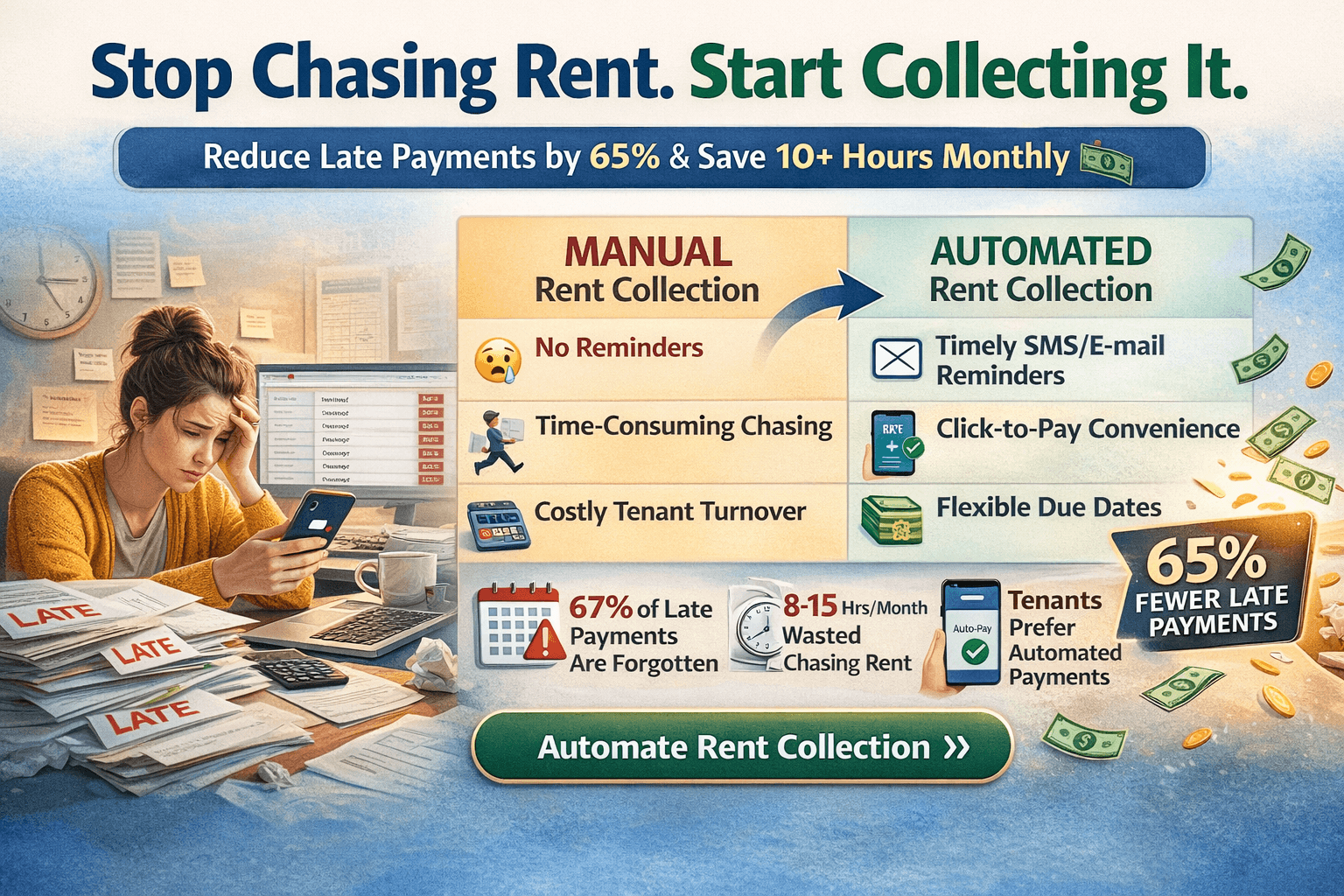
Most operators assume late rent is a tenant-quality problem. Get better tenants, the thinking goes, and late rent goes away. The data does not support the assumption. Late rent in 2026 is mostly a friction problem and a memory problem, not a tenant problem. Tenants who fully intend to pay forget, mis-time the payment, hit a payday timing gap, or run into a 10-minute friction on the payment portal that they will get to later and never do. The lever is not selection. It is removing the friction and remembering on the tenant's behalf.
This post lays out the four real reasons rent goes late at mid-market property management operators in 2026, the AI-assisted nudge pattern that compresses delinquency 30-50% without adding staff, the three hardship scenarios where AI should hand the conversation back to a human, and the 30-day shape we run when scoping rent communication automation at property management clients.
Key takeaways
- Most late rent is friction or forgetting, not deliberate non-payment. Removing the 30-minute friction window between intent and action collects rent earlier than chasing delinquent tenants does.
- The nudge sequence that works in 2026: 3 days before due, day of, day after late, day 3 late, day 7 late. AI handles all five touches at a per-tenant cadence the manual team cannot match.
- Hardship conversations route to a property manager within 60 seconds of detection. The AI never negotiates payment plans; it captures the request and hands off.
- Operators running this pattern compress delinquency 30-50% on portfolios above 100 doors without adding accounting staff. The savings compound through the year as fewer accounts age into deeper delinquency.
The four real reasons rent goes late
1. Forgetting. The tenant intends to pay. The rent reminder did not land where they look. Auto-pay never got set up because the portal session timed out the first time the tenant tried. They will pay this weekend; this weekend turns into next weekend; by day 7 the late fee triggers and the tenant is annoyed at the operator. Forgetting accounts for 40-60% of late rent in most mid-market portfolios.
2. Payday timing. Rent is due on the 1st. The tenant's pay hits on the 5th. The tenant has been moving small amounts to cover the gap and ran into a difficult month. The payment will come; the timing is wrong. Payday-timing gaps account for another 20-30% of late rent. The right response is a flexible payment date if the lease permits, not a stronger late notice.
3. Friction in the payment portal. The tenant tries to pay. The PMS portal asks for a saved payment method that is not on file. The tenant abandons the session intending to come back. They do not. Parallel analysis in service businesses documents the same pattern: small friction at a payment moment produces large downstream collection cost.
4. Genuine hardship. Job loss, medical event, family emergency. This is the category that needs a property manager's judgment immediately. The AI's job is to identify hardship signals (specific language patterns, payment history changes, prior hardship context) and escalate within minutes.
The proportions vary by portfolio, but the order of magnitude does not. Mostly forgetting, mostly friction, partly timing, occasionally hardship. The right tools target the first three; the human takes the fourth.
The AI nudge sequence that compresses delinquency
The pattern that works across portfolios at customer service automation engagements is a five-touch sequence over 10 days. Each touch comes through the tenant's preferred channel (text, email, voice, in-app), is acknowledged with one-click pay where possible, and routes any tenant response back to either auto-collection (if the response is "I will pay tonight") or to the property manager (if the response is anything indicating hardship).
Touch 1 (3 days before due): friendly reminder with one-click pay link. The goal is to capture the tenants who would have paid on time anyway but might have missed the date.
Touch 2 (day of): same-day reminder. Different tone (matter-of-fact, not pushy). Captures the tenants who pay the day rent is due as part of their financial routine.
Touch 3 (day after late): "rent is past due" acknowledgment. Still friendly; no penalty triggered yet. Most operators report 30-50% of day-after notices result in same-day payment.
Touch 4 (day 3 late): late notice with the fee assessed per the lease. The notice should include the option to pay now with the fee, plus a link to request a hardship conversation. The hardship link routes to a property manager.
Touch 5 (day 7 late): formal demand notice if the lease still permits. By day 7, the right action is human-led. The AI's job is to surface the unpaid accounts to the property manager with full context attached.
The five-touch sequence works because it spreads the reminder pattern across enough touchpoints that forgetting becomes hard, and because each touch carries the lowest-friction action available at that moment. Salesforce's framing of AI in customer service aligns with the same procedural-touch approach.
What 2026 data shows about rent collection and tenant communication
- Industry analysis of service-business communication and contract retention: response-gap moments produce most of the downstream operational pain. PM rent collection sits in the same pattern. Source.
- Salesforce on AI in customer service: AI features delivering durable value operate at the intersection of behavioral data and operator workflow data. Rent communication has both. Source.
- Forrester on chatbot business case: the AI deployments that fail at renewal lack documented baselines. PM rent automation that cannot point to compressed delinquency days or recovered staff hours fails the same way. Source.
- Kustomer on reducing inbound ticket pressure: the right starting point for any AI customer-comm build is triage and procedural offload, not deflection of high-stakes conversations. Source.
- Zendesk on ticket deflection: deflection is the currency of self-service; rent inquiries fit the deflection pattern when the answer is a balance lookup or a payment link. Source.
- McKinsey 2025 State of AI: the operators who rewire their rent communication flow around AI handoffs capture more value than the ones who bolt AI onto an unchanged process. Report PDF.
- Gartner April 2026: AI projects across IT and operations are stalling ahead of meaningful ROI without baseline discipline. PM-AI is no exception. Source.
- RAND on AI deployment risk: misalignment between AI capability and business problem is the consistent root cause of failure. PM rent automation that asks AI to negotiate hardship is exactly the misalignment pattern. Source.
The three hardship scenarios AI should not handle
Scenario 1: tenant requests a payment plan. The AI captures the request, acknowledges it within 60 seconds, and routes to the property manager. The AI never offers terms; the operator does.
Scenario 2: tenant cites job loss, medical event, or family emergency. Immediate escalation. The AI's job is to recognize the language pattern and hand off to a human in minutes, not at the next touchpoint in the sequence.
Scenario 3: tenant raises eviction or non-renewal concerns. Any conversation where the property's response materially affects the tenant's housing security has to be on a human. The reputational and legal cost of AI-driven eviction-adjacent messaging is much larger than the time saved.
The principle across all three: AI handles the procedural rent-collection workflow. AI does not handle the moments where the tenant's housing or financial life is being negotiated. AI agent development engagements at PM clients consistently scope this split on the discovery call.
The 30-day implementation shape we run at Hexa
At Hexa AI Agency we run the same shape when a PM operator asks us to scope rent communication automation. Across the engagements we have shipped, the operators that landed real delinquency compression followed roughly this order.
Week 1: lock the baseline. Pull 12 months of rent collection data. Measure four numbers: average days-to-collection by month, delinquency rate at 30 days, late-fee revenue (which should drop as the AI works), and accounting-team hours per month on collections. Document the attribution formula: if days-to-collection compress by 4 days on a 200-door portfolio, what is the dollar impact on cash flow and recovered hours?
Week 2: build the nudge sequence. Configure the AI for the operator's PMS integration, communication channels, lease-fee schedule, and hardship-escalation rules. Pilot on one property first. The auto-pay-link path runs without human touch; the hardship path routes to the property manager.
Week 3: launch on the pilot property. Run the five-touch sequence end to end. Watch the day-after-late payment rate, the day-3 hardship-conversation request rate, and tenant satisfaction signals.
Week 4: measure and decide. Compare baseline against week 4. If delinquency days compressed and tenant satisfaction held flat or improved, roll the same sequence to the rest of the portfolio. If tenant complaints lifted, the tone or cadence needs tightening before expansion.
Budget realistically. A PM-focused rent communication AI build lands in the $6,000-$15,000 range one-time, plus $300-$800 per month for the AI usage on top of your existing PMS. Most operators see net-positive ROI inside the first 90 days from compressed collection cycles alone, before counting recovered staff hours.
Frequently asked questions
Does AI rent communication actually compress delinquency?
Yes, by 30-50% on portfolios above 100 doors in the deployments we have shipped and the industry data we have reviewed. The compression comes from the five-touch nudge sequence matching the procedural reasons rent goes late (forgetting, friction, timing), not from the AI being smarter than the property manager.
Will AI rent communication damage tenant relationships?
Not if configured with the right tone and escalation rules. Tenants typically prefer the consistency of the AI's reminder cadence to the inconsistency of manual follow-up. The damage comes from AI tone that reads as corporate-helpdesk or AI logic that fails to route hardship to a human. Both are configuration choices, not inherent traits.
How much does AI rent communication automation cost in 2026?
$6,000-$15,000 one-time for a PM-focused build integrated with your PMS, plus $300-$800 per month for the AI usage. Native PMS features cover the basics at lower cost; layered AI is worth the spend on portfolios above 100 doors where the volume justifies the configuration work.
When is rent communication automation the wrong investment?
When the portfolio is under 50 doors, when hardship-escalation rules are not yet documented, or when the PMS does not expose payment status via API. Fix the data access first; deploy the AI layer second once the API is wired up.
One warning worth heeding: a rent-reminder sequence can show every message as sent while the tenant never actually receives it, an auth token expires or a field changes and nothing errors. We cover how to catch that silent kind of failure in why your automations report success while quietly doing nothing.
If you are evaluating a rent communication AI build for your PM operation and want a second opinion on the scope, book a call at cal.com/hexaiagency and we will read the proposal with you, free. We do this often for operators running broader AI workflow automation across rent, maintenance, lease renewal, and move-in coordination, where the same behavioral data and PMS integration powers all four workflows from a single build rather than four separate point solutions.