
9 min readUpdated
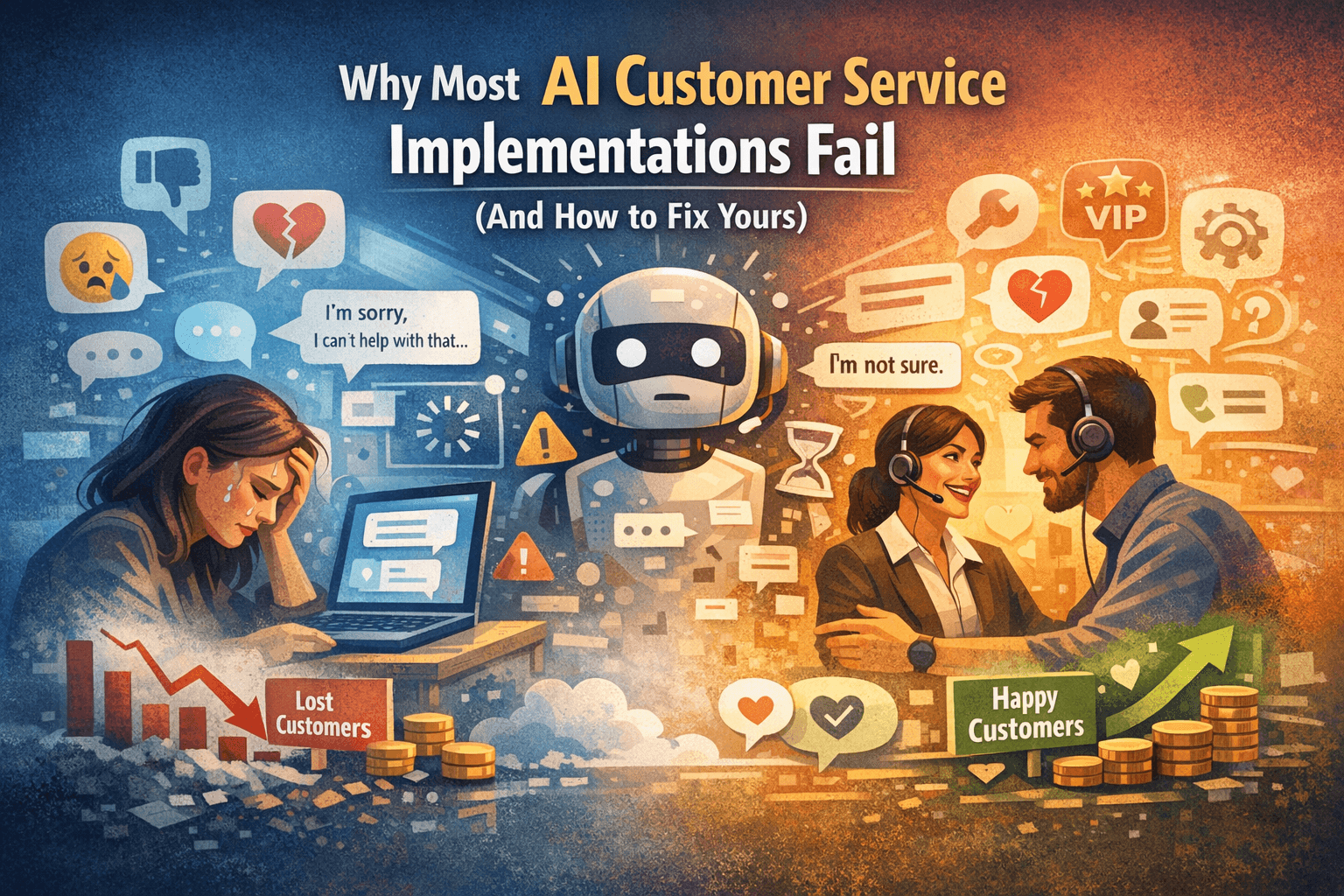
Where AI Fails Customer Service in 2026 (and Recovery)
The four scenarios where AI customer service costs you customers, the three real warning metrics, and the recovery playbook when the bot has already done damage.

Mike
Founder & AI Automation Lead
Every quarter we get at least one inbound asking us to rebuild a customer service AI that the buyer's previous vendor shipped 12 months ago. The complaint is rarely about the model. It is about the customer who churned after a bot misunderstood them, the chargeback the bot triggered by issuing a wrong refund, the negative review left after the bot's third "I don't have that information" reply. The AI did exactly what it was configured to do. The configuration was the failure.
This post lays out the four scenarios where AI in customer service costs you customers in 2026, the warning signs that your current AI is producing more loss than savings, the recovery playbook when the bot has already damaged customer trust, and the 30-day rebuild shape that puts the AI back in its right scope. By the end you should know exactly when to pull AI out of a customer conversation and put a human back in.
Key takeaways
- AI fails customer service in four predictable scenarios: refunds outside policy, billing disputes, emotional escalations, and regulated questions. Letting AI handle these costs more than the labor it saved.
- The early warning sign is not deflection rate. It is CSAT, repeat-contact rate, and chargeback rate. Watch those three; deflection alone is a vanity metric.
- The recovery playbook is not "tune the bot." It is to narrow the bot's scope back to procedural tasks and re-route every judgment case to humans within 60 seconds.
- Activity-vs-outcome is the right operating split. Automate the activities, route the outcomes that have consequences.
The four scenarios where AI customer service costs you customers
Scenario 1: refunds outside policy. A customer asks for a refund the bot interprets as within-policy when it actually requires a goodwill exception, or vice versa. The bot either issues a refund the company would not have authorized (margin loss) or denies one the company would have approved (customer loss). Both versions of the failure are quiet at the time and visible at the next quarter's churn analysis. Fin's analysis of AI support cost reduction makes the same distinction in vendor language: lean into procedural volume, route everything judgmental.
Scenario 2: billing disputes. A customer asking "what is this charge?" is half angry, half confused, and one bad reply away from a chargeback. The bot can summarize the charge accurately, but it should not be the one defending it. Chargebacks cost more than the disputed amount, both in fees and in payment-processor relationship damage. The bot saving five minutes of CSR time on a dispute that ends in a chargeback is a net loss of $20-$50 plus the lifetime value of the customer.
Scenario 3: emotional escalations. The customer is upset. The bot, trained on neutral interactions, replies with a neutral acknowledgment. The customer reads the neutral acknowledgment as dismissive and escalates harder. By the time a human gets the conversation, the relationship has already cooled to a point a CSR would have caught earlier. The bot did not produce the emotion; it failed to read it.
Scenario 4: regulated questions. Insurance interpretations, medical adjacent advice, legal questions, anything where the wrong answer creates liability. The model produces confident answers on subjects where confidence is the wrong stance. The bot's reply becomes evidence in the next compliance review or the next lawsuit. The agencies still shipping non-routed regulated-question handling in 2026 are pricing in zero liability exposure that will come due eventually.
The pattern across all four scenarios: the bot did not fail technically. It produced exactly the output it was configured to produce. The failure was a scoping decision made on the first discovery call, before the configuration ever got designed.
The early warning signs your bot is producing loss
Vendor decks lead with deflection rate as the primary metric. Deflection rate is a vanity metric on its own. The three numbers that actually predict whether the bot is producing net value:
1. CSAT on AI-handled tickets vs human-handled tickets. The benchmark is "AI-handled CSAT within 5 points of human-handled CSAT." If AI-handled CSAT is consistently 8+ points below human-handled, the bot is shipping bad experiences that customers are remembering. The deflected ticket did not save money; it banked future churn.
2. Repeat-contact rate within 7 days. If a customer comes back inside a week, the AI did not actually resolve the original ticket. The reported "deflection" was a hand-off the customer rejected. Kustomer's data on reducing support tickets consistently identifies repeat-contact rate as the truer measure of resolution quality.
3. Chargeback rate among AI-handled billing tickets. Chargebacks attributable to a billing interaction the bot handled. If this number is non-zero and concentrated on AI conversations, the bot is producing the kind of customer friction that triggers payment-processor disputes. Watch it monthly; this is the failure mode most likely to escape your CSAT survey.
If any of these three numbers is moving in the wrong direction, the bot needs scope reduction, not more training data. Adding more data to a bot operating outside its scope produces more wrong answers, not fewer.
What 2026 industry data says about AI customer service failure modes
- Forrester on the chatbot business case: the chatbots that fail at renewal almost always lack a documented business case that ties the bot's output to a P&L line. The model is rarely the problem. Source.
- Zendesk on ticket deflection: deflection is the currency of self-service, but only when the deflection actually resolved the question. Reported deflection that did not resolve becomes future ticket volume. Source.
- Kustomer on AI ticket deflection: the prerequisites for deflection are knowledge-base quality and intent classification accuracy. Bots deployed against stale knowledge bases produce stale answers. Source.
- Kustomer on AI triage: triage is the lower-risk starting point because it routes rather than answers. Misrouting is easier to recover from than misanswering. Source.
- Salesforce on AI in customer service: the AI features delivering durable value sit at the intersection of customer behavior data and the company's own workflow data. Generic AI applied to generic queries underperforms the same AI deployed against company-specific data. Source.
- Spiceworks on after-hours support: the queue-management failure mode that pushes teams to deploy AI in the first place is the same failure mode that produces poorly scoped deployments. Fix the queue management first, then deploy AI. Source.
- Gartner April 2026: AI projects across IT and operations are stalling ahead of meaningful ROI. Customer service AI without an attribution model fits the same pattern. Source.
- MIT NANDA 2025: 95% of corporate generative AI pilots produce zero measurable revenue impact. Customer service deployments sit in this distribution unless scoped to procedural workflows with documented baselines. Analysis.
The recovery playbook when the bot has already done damage
Step 1: pull the bot out of every scenario in the four categories above. If your bot is currently handling refunds, billing disputes, emotional escalations, or regulated questions, route those categories to humans immediately. Do this before any other work; the bleed continues until the routing changes.
Step 2: narrow the bot's scope to procedural tasks with deterministic answers. Order status, tracking lookups, password resets, business-hours questions, return-label generation inside policy. These are the categories where the bot produces real time savings and zero customer damage.
Step 3: add a clear escalation trigger on emotional language. Anger, distress, "speak to a manager," "this is the third time I have called" should all trigger an immediate human handoff with the full transcript attached. The handoff is not a failure of the AI; it is the AI's correct behavior.
Step 4: write a one-page "AI scope" document that says exactly what the bot will and will not do, and circulate it inside the team. The CSR team needs to see it because they need to trust the bot's judgment about when to escalate. The leadership team needs to see it because they need to know what the bot is responsible for and what it is not. Our on-site AI chat system case study documents a build with this kind of explicit scope.
The 30-day shape for a clean customer service AI build
At Hexa AI Agency we run the same shape when a client asks us to ship or rebuild customer service automation. Across the engagements we have shipped, the teams that produced durable CSAT-neutral or CSAT-positive AI builds followed roughly this order.
Week 1: lock the baseline and the scope document. Pull 90 days of ticket data, segmented by category. Document current first-response time, CSAT by category, repeat-contact rate, and chargeback rate. Write the AI scope document: which categories the AI handles, which it routes, which it never touches. Both sides sign off.
Week 2: build triage on one queue. Pick the highest-volume queue (usually order status, returns, or password reset). Configure the AI to classify and route the deterministic ones, pass the rest to humans with full context. Resist scope creep into emotional or judgment-heavy categories.
Week 3: launch deflection on FAQ-eligible categories. Turn on the bot only for the categories the scope document authorizes. Watch CSAT, repeat-contact rate, and chargeback rate in parallel. If any of the three drops more than 5 points, narrow the scope.
Week 4: measure and decide. Compare baseline against week 4. If first-response time dropped, CSAT held, and repeat-contact rate stayed flat or improved, expand to a second category. If CSAT dropped, the bot is confidently wrong; pull back the categories where the drop concentrated. AI agent development engagements at Hexa follow exactly this shape.
Budget realistically. A diagnostic-first customer service AI build on top of your existing helpdesk lands in the $8,000 to $20,000 range one-time, plus $200 to $800 per month for the AI usage. A platform-only solution with no implementation work is usually selling a chat widget, not a customer service workflow.
Frequently asked questions
What is the right metric to watch for AI customer service health?
Three numbers in parallel: CSAT on AI-handled tickets, repeat-contact rate within 7 days, and chargeback rate among AI-handled billing interactions. Deflection rate is a vanity metric without these three; deflection that fails on any of the three is producing future loss the deflection counter does not capture.
How do we know when to pull AI out of a customer interaction?
Three triggers, in order of importance. The customer used emotional language (anger, frustration, distress). The interaction touched billing, refunds, regulated topics, or anything outside the AI's authorized scope. The conversation reached three exchanges without resolution. Any one of these should hand the conversation to a human within 60 seconds with the full transcript.
Can we recover customer trust after AI shipped a bad experience?
Often yes, on a per-customer basis, by having a CSR follow up personally with context and a goodwill gesture. Recovering trust at the brand level is harder; it requires public scope correction (the team narrowed the AI's scope back to procedural) and consistent execution against the new scope for at least a quarter. Customers stop trusting brands faster than they start trusting them again.
When is AI customer service genuinely the right answer?
When the volume is high, the queries are procedural, the knowledge base is current, the escalation paths are wired, and the leadership team has aligned on activity-vs-outcome scope. All five conditions; not four out of five. Missing any one of these is where the failure modes start.
If you are evaluating an AI customer service build or recovering from one that produced damage, book a call at cal.com/hexaiagency and we will read the proposal or audit the existing build with you, free.