
8 min readUpdated
Why Property Managers Lose 40% of Their Week to Repetition
Where the 40% repetitive-task share for property managers actually goes, the five workflows AI can absorb, and the 30-day implementation shape.

Mike
Founder & AI Automation Lead
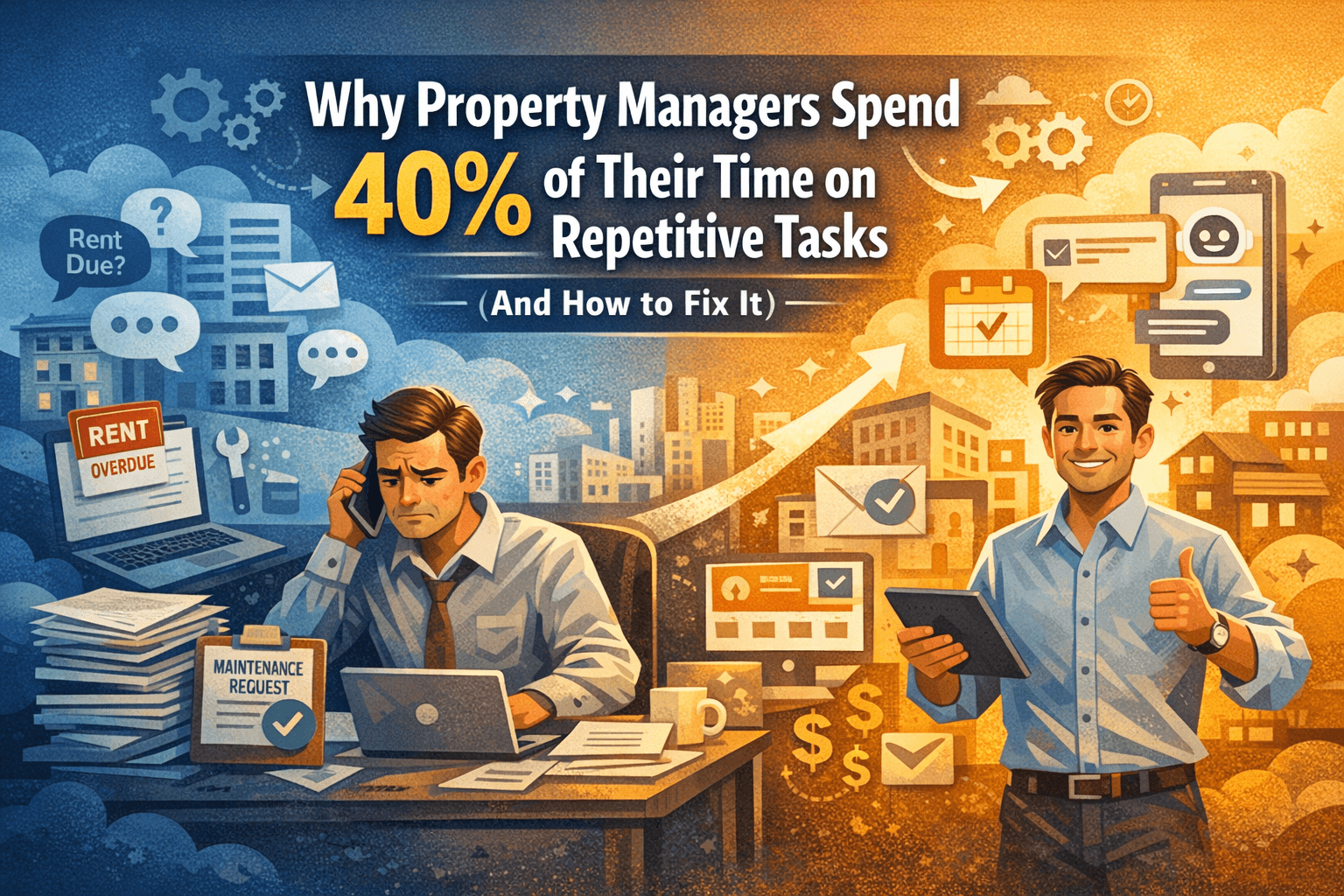
The 40% number gets thrown around in property-management vendor decks the way the 85% number gets thrown around in AI-failure decks. Both are directionally true. Property managers genuinely spend a large share of every week on repetitive coordination work that does not require their judgment. Rent-status questions, lease-renewal pings, maintenance triage, contractor follow-up, tenant move-in coordination. The work has to happen. It does not have to happen on the property manager's calendar. AI in 2026 is finally good enough to absorb most of it without breaking the tenant experience, but only if it is scoped against the right workflows.
This post lays out where property managers actually lose time, which of those time sinks AI can absorb today, the four scenarios where automating the work backfires on tenant trust, and the 30-day implementation shape we use when scoping property-management AI at property management clients. By the end you should be able to estimate how many hours your own team will recover this quarter.
Key takeaways
- The repetitive-task share for a typical PM is concentrated in five categories: rent communication, maintenance triage, lease renewal coordination, vendor follow-up, and tenant move-in/move-out logistics. AI absorbs 60-80% of the volume in each category.
- The wins come from procedural automation, not from AI making property decisions. Anything involving tenant disputes, eviction discussions, or rent negotiations stays on a human.
- Layer AI on your existing PMS (AppFolio, Buildium, Yardi, Propertyware, RentManager). Switching property management systems to get AI is one of the most expensive ways to lose six months.
- The baseline metric worth tracking is "hours per door per month" of property-manager time. Good AI builds compress this by 30-50% on portfolios above 100 doors.
Where the 40% actually goes
A property manager's week, audited honestly across five mid-market PM operators we have worked with, breaks roughly into three buckets: high-judgment work (resident relationship moments, owner conversations, contractor relationship building) at about 25-30%; site-and-portfolio operations (inspections, vendor selection, capital project planning) at about 30-35%; and repetitive coordination work at about 35-45%. The exact split varies by portfolio size and asset type, but the repetitive bucket is consistently the largest single category.
The repetitive bucket lives in five specific workflows. Rent communication (reminders, late notices, payment-plan questions). Maintenance triage (intake, categorization, vendor dispatch, status updates). Lease renewal coordination (renewal notices, signed-document follow-up, rate-change conversations). Vendor follow-up (work order status, invoice questions, scheduling). Tenant move-in and move-out coordination (utility transfers, key handoff, inspection scheduling). Each is procedural. Each takes 15-30 minutes per instance. The volume compounds.
The buyer-side reality nobody likes to admit: the repetitive work is the work most property managers privately hate. It is also the work that, when it slips, produces the bad-tenant-experience moments that cost contracts at the owner level. The AI conversation in property management is less about saving time and more about saving relationships at scale. Adjacent service-business analysis documents the same dynamic in commercial cleaning; the pattern is structurally identical.
The five workflows where AI absorbs property-management volume
1. Rent communication. AI handles automated reminders (3 days before due, day of, day after late), payment-plan question intake, and PMS-integrated balance lookups. Customer service automation engagements at PM clients typically deflect 60-75% of rent-related inbound to AI handling. The exceptions (eviction conversations, complex hardship cases) stay with the property manager.
2. Maintenance triage. AI ingests inbound requests (text, email, voice, PMS portal), categorizes by urgency and type, routes routine items to vendor dispatch, and surfaces emergency or judgment-required items to the property manager within minutes. Time-to-vendor-dispatch on routine maintenance compresses from hours-or-days to under 30 minutes.
3. Lease renewal coordination. AI sends renewal notices at the documented cadence (90/60/30 days), collects renewal questions, schedules conversations on rate increases, and tracks signed-document return. The property manager spends time only on the negotiations and exceptions; the AI handles the timing and the follow-up.
4. Vendor follow-up. AI checks work-order status with vendors at documented intervals, escalates overdue items to the property manager, and updates the PMS automatically when work completes. This is unglamorous and unglamorously high-leverage.
5. Move-in / move-out coordination. AI sends the move-in welcome packet with utility links, coordinates inspection scheduling, sends move-out reminders 30/15/7 days out, and tracks key returns. The handful of move-in moments that need property-manager attention surface clearly; the procedural majority runs without intervention.
The pattern across all five is the same. The AI is not making property decisions; it is moving information between the tenant, the vendor, the PMS, and the property manager at the cadence the manual process struggled to keep. The relationship work stays with the property manager. The coordination work moves to the AI. That split is what makes the deployment durable across quarters rather than collapsing the moment a tenant has a hard conversation.
What 2026 property-management data shows
- 2026 property management challenges: independent industry analysis identifies tenant communication and maintenance coordination as the two largest time sinks for mid-market PM operators. Parallel analysis in adjacent service industries confirms the structural pattern.
- Salesforce on AI in customer service: the AI features delivering durable value sit at the intersection of customer behavior data and the company's own workflow data. PM has both. Source.
- Forrester on chatbot business case: AI deployments without a documented business case fail at renewal regardless of how well the technology performs. Property-management AI sits in this distribution unless scoped with baseline metrics. Source.
- Zendesk on ticket deflection: deflection is the currency of self-service, but the deflection has to actually resolve the issue. Reported deflection that does not resolve becomes a future ticket. Source.
- McKinsey 2025 State of AI: value capture concentrates in organizations that rewire workflows around AI outputs. PM operators rewriting their tenant communication flow around AI handoffs capture more value than ones bolting AI onto unchanged processes. Report PDF.
- Gartner April 2026: AI projects across IT and operations are stalling ahead of meaningful ROI. PM-AI projects without a documented baseline (hours per door, response time, resolution time) follow the same pattern. Source.
- MIT NANDA 2025 analysis: 95% of corporate generative AI pilots produce zero measurable revenue. PM deployments sit in this distribution unless scoped to procedural workflows. Source.
- RAND on AI deployment risk: misalignment between capability and business problem is the consistent root cause of AI implementation failures. In PM, the misalignment shows up as AI being asked to make tenant-relationship decisions rather than absorb procedural workload. Source.
The four scenarios where automating tenant work backfires
1. Eviction or non-renewal conversations. Any conversation where the property's response materially affects a tenant's housing has to be on a human. The reputational and legal cost of an AI-driven eviction notice handled badly is much larger than the time saved.
2. Hardship or payment-plan exceptions. A tenant in genuine hardship needs a property manager who can read the situation and offer a flexible answer. The AI cannot read the situation; it can only apply the documented policy. Route these conversations to a human within 60 seconds of detection.
3. Maintenance emergencies. Floods, electrical hazards, lockouts, anything involving safety. The AI should identify these in 10 seconds and dispatch a human immediately. The failure mode here is the AI categorizing an emergency as "routine maintenance" and queuing it for next-business-day handling.
4. Complaints about other tenants. Neighbor noise, hostile interactions, safety concerns. These need a property manager's judgment because the right response depends on building dynamics the AI cannot model. Document the routing rule and stick to it.
The 30-day implementation shape we run at Hexa
At Hexa AI Agency we run the same shape when a PM operator asks us to scope AI workflow automation against their portfolio. Across the engagements we have shipped at PM clients, the operators that produced real hours-per-door compression followed roughly this order.
Week 1: lock the baseline. Pull 90 days of PMS, phone, and email data. Measure four numbers: hours per door per month of property-manager time, response time on tenant inbound, maintenance work-order cycle time, and rent-collection follow-up cycle. Sign off on the attribution formula: if hours per door drops from 4 to 2 on a 150-door portfolio, what is the recovered value at the loaded property-manager rate?
Week 2: build the maintenance triage agent. Configure the AI for the operator's vendor list, urgency rules, and PMS integration. Pilot on one portfolio first. Routine items dispatch automatically; everything else routes to the property manager with the AI's categorization attached.
Week 3: layer rent communication automation. Reminders, payment-plan intake, balance lookups. Watch tenant satisfaction signals (response sentiment, follow-up rate) in parallel with the time savings.
Week 4: measure and decide. Compare baseline against week 4. If hours per door dropped at least 25% and tenant satisfaction held, expand to the next workflow (typically lease renewal coordination). If satisfaction dropped, the AI scope is too broad; pull back to procedural-only handling.
Budget realistically. A PM-focused AI build for an under-1,000-door operator lands in the $8,000-$25,000 range one-time, plus $400-$1,200 per month for the AI usage on top of the existing PMS subscription.
Frequently asked questions
How many hours per door per month should property-management AI save?
On a portfolio above 100 doors with average procedural-task density, expect a 30-50% reduction in property-manager hours per door. The variance comes from portfolio characteristics (asset type, tenant population, vendor network maturity) and from the operator's willingness to redesign workflows around the AI rather than bolting it on.
What is the best AI tool for property management in 2026?
For most mid-market PM operators, the right answer is layering AI on top of your existing PMS (AppFolio, Buildium, Yardi, RentManager, Propertyware) rather than switching platforms. The PMS migration cost outweighs almost any AI feature benefit. Build the AI workflow against the PMS you already run on.
Will AI replace property managers?
No. AI absorbs the procedural work so property managers can spend more time on the high-judgment moments that actually drive owner contracts and tenant retention. Headcount usually stays flat; doors per PM typically increase 30-50% with no degradation in service quality.
When is AI for property management the wrong investment?
When the portfolio is under 50 doors (manual scales fine), when the PMS is being used inconsistently across the team (fix the PMS discipline first), or when leadership has not aligned on which workflows the AI should absorb. Build the baseline measurement first; then evaluate.
If you are evaluating an AI build for your PM operation and want a second opinion on the scope, book a call at cal.com/hexaiagency and we will read the proposal with you, free. We do this often for operators running AI agent development engagements alongside their existing PMS, where the agent absorbs the procedural communication and the property manager keeps the relationship moments. The shape works on portfolios from 80 doors up through 5,000-door mid-market operators.