
8 min readUpdated
What Does Business AI Automation Actually Cost in 2026?
Honest budgets across one-time build, ongoing platform, AI usage, and hidden costs. Single-workflow $8K-$30K; multi-workflow $40K-$120K; plus 25-35% buffer.

Mike
Founder & AI Automation Lead
"What does AI automation cost?" is the question every small business owner asks on the first vendor call. The honest answer is that the question is incomplete. AI automation costs vary by roughly 10x between the cheapest configurable platform and the most thorough custom build, and the right number for a given operator depends on portfolio scale, integration complexity, and the specific workflow being absorbed. Quoting a single number is dishonest; quoting a range without context is unhelpful. This post lays out the honest cost structures across the categories of AI automation in 2026.
By the end you should be able to estimate your own AI automation budget across one-time build cost, ongoing platform cost, ongoing AI usage cost, and the hidden costs vendors do not advertise.
Key takeaways
- AI automation costs split into four categories: one-time build/integration, ongoing platform subscription, ongoing AI usage (per-token or per-call), and the hidden costs (data hygiene, team training, ongoing tuning).
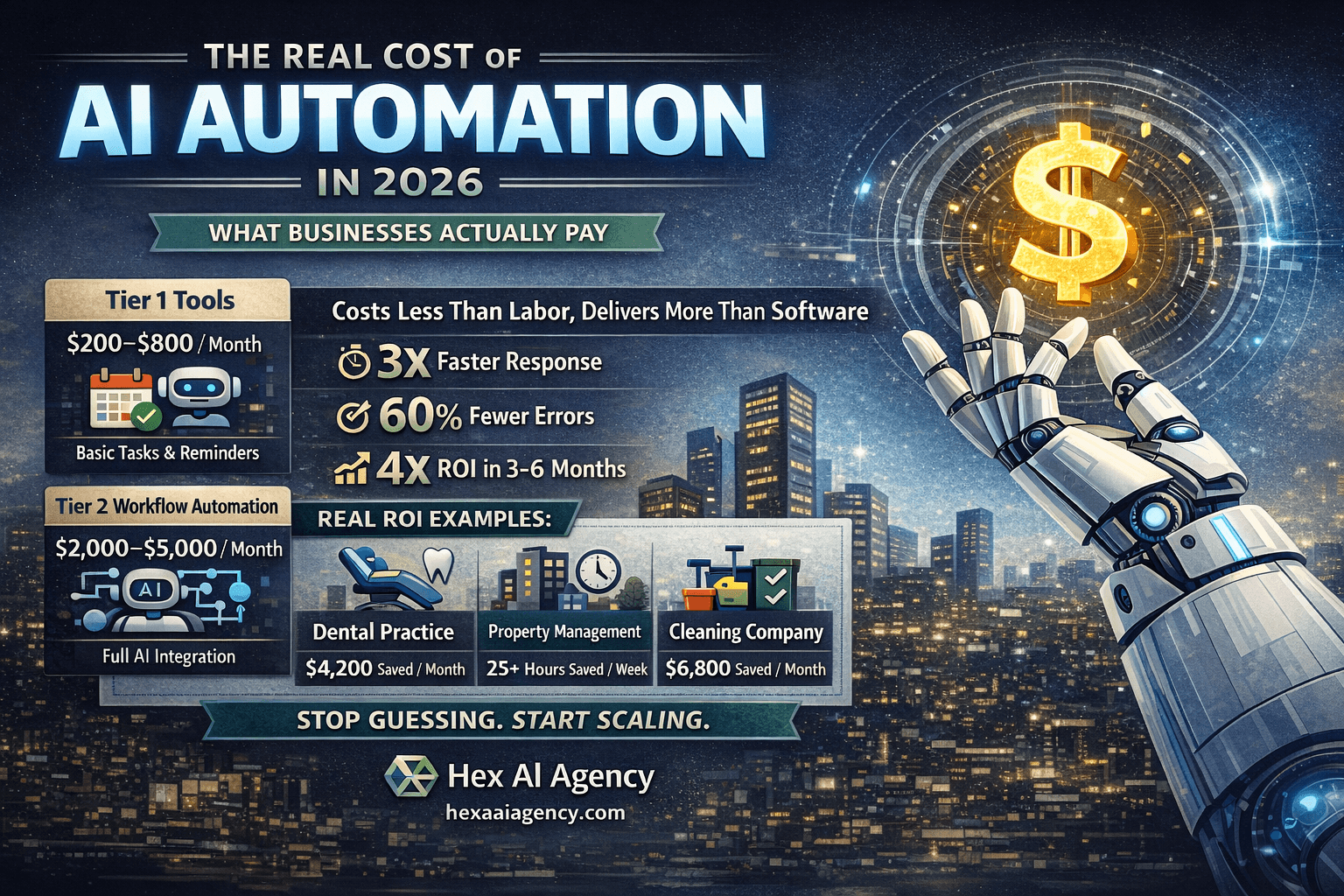
- For a service business under 200 people, expect $8K-$30K one-time for a single-workflow build, plus $200-$1,500 per month for platform plus AI usage. Multi-workflow builds run $40K-$120K one-time.
- The hidden costs are typically 20-40% of the visible build cost. Operators who under-budget this number experience the cost gap as a "scope creep" problem when it is actually a planning problem.
- The cheapest option is rarely the right one for a service business. A $50/month plug-and-play tool that does not integrate with your stack costs more in friction than a $15K custom build that does.
The four cost categories that make up an honest AI budget
Category 1: one-time build and integration. This is the work to configure the AI, integrate it with your existing systems (CRM, PMS, helpdesk, accounting), define the routing rules, train the team, and run the 30-day pilot. For a single-workflow build at a mid-market service business, expect $8K-$30K depending on complexity. Multi-workflow rebuilds run $40K-$120K.
Category 2: ongoing platform subscription. The underlying SaaS the AI sits on. CRM ($30-$150/user/month), PMS ($1-$5/door/month), helpdesk ($25-$150/user/month). These are not strictly AI costs; they are operating costs that the AI builds on top of. If you are not yet running these platforms, you need them before deploying AI.
Category 3: ongoing AI usage. The variable cost of running the model. Anthropic, OpenAI, or other LLM API costs scale with token usage. For most service-business workflows, this lands in $200-$1,500 per month depending on volume. Voice AI is usually higher due to per-minute pricing. Anthropic's documentation details the pricing structure for the most common service-business use cases.
Category 4: hidden costs. Data hygiene (the unglamorous week or two before any AI deployment), team training (every team affected by the AI needs to understand the workflow change), ongoing tuning (most builds require small adjustments at month 1, 3, and 6), and audit-trail maintenance. The hidden costs typically run 20-40% of the visible build cost across the first year.
Honest 2026 budgets by service-business size and scope
Under 50 employees, single workflow: $6K-$15K one-time, $200-$500 per month ongoing. This is the entry point for most small service businesses. Common builds: customer service triage, rent reminders, appointment reminders, or basic AP automation.
50-200 employees, single workflow: $10K-$25K one-time, $400-$1,000 per month ongoing. The integration complexity rises with team size; the AI configuration usually needs to account for multiple roles and approval rules.
50-200 employees, multi-workflow: $30K-$70K one-time, $800-$2,000 per month ongoing. Common scope: customer service plus CRM automation, or maintenance plus rent communication for PM operators. The phased deployment shape is the way to manage the cost across a quarter or two rather than all at once.
200-500 employees, multi-workflow with custom integration: $50K-$120K one-time, $1,500-$3,500 per month ongoing. The integration work scales because the existing tech stack is usually more complex (multiple systems, more roles, more approval rules).
Enterprise (500+ employees): different category entirely. Not covered in this post; the dynamics shift toward platform consolidation projects rather than workflow-layer builds.
What 2026 data shows on AI implementation budgets
- McKinsey 2025 State of AI: the spending pattern that produces value concentrates in operating-model change rather than tool selection; AI budget alone does not predict ROI. Source.
- BCG 2024 on GenAI bottom-line impact: only a fraction of companies translate GenAI investment into measurable revenue. The fraction is concentrated in operators who scoped against documented baselines. Source.
- Gartner April 2026: AI projects across IT and operations stall ahead of meaningful ROI when budgets are allocated without baseline measurement. The cost is wasted regardless of size. Source.
- MIT NANDA 2025 analysis: 95% of corporate generative AI pilots produced zero measurable revenue impact. The implication is that 95% of the AI budget allocated in 2024-2025 produced no measurable financial return. Source.
- Forrester on chatbot business case: AI deployments lacking documented baselines fail at renewal; budget without baseline is wasted budget. Source.
- Salesforce on AI in customer service: integration cost dominates platform cost for AI deployments in service businesses; budget accordingly. Source.
- RAND on AI deployment risk: misalignment between capability and budget is the consistent root cause of failed implementations. Source.
- Industry analysis on coordination economics: the operating costs the AI absorbs (supervisor hours, slipped revenue, churn) are typically larger than the AI cost itself; the math closes if scoped correctly. Source.
The hidden costs vendors do not advertise
Hidden cost 1: data hygiene. Two to four weeks of work before any AI deployment to clean the CRM, PMS, or ERP data the AI will operate on. Typically $3K-$8K of internal or external labor, often the most expensive surprise in the project.
Hidden cost 2: team training and adoption. Every team affected by the AI workflow needs to understand what the AI does, what they continue to own, and how to escalate. Allow 5-15 hours per affected team member for training and first-month support.
Hidden cost 3: ongoing tuning. Most AI builds require small adjustments at month 1, 3, and 6 as edge cases surface in production. Budget 10-20% of the build cost annually for ongoing tuning, either internal or via the original vendor.
Hidden cost 4: audit-trail maintenance. The audit log only stays useful if someone reviews it periodically. Plan for monthly review time to spot patterns the AI handled incorrectly and to refine the routing rules.
Hidden cost 5: vendor lock-in risk. Switching AI vendors is more expensive than switching SaaS platforms because the workflow integration is custom per vendor. Choose vendors with API-accessible workflows so you can migrate if needed.
How to set an honest AI budget for your operation
At Hexa AI Agency we run the same budgeting conversation when scoping AI workflow automation across service businesses. Across the engagements we have shipped, the operators that set honest budgets followed roughly this approach.
Step 1: scope to one workflow. The total budget for a single-workflow build at your business size, including hidden costs, lands in the ranges above. Multi-workflow ambitions multiply quickly; phase them across quarters.
Step 2: document the baseline metric and attribution formula. The budget is only defensible if it ties to a specific dollar outcome. If you cannot connect the AI spend to a number on your finance team's monthly report, the budget is premature regardless of size.
Step 3: add 25-35% for hidden costs. This is the buffer most operators do not realize they need. Include data hygiene, team training, ongoing tuning, and audit-trail review in the explicit budget so the vendor cannot frame them as "scope creep" later.
Step 4: plan the 30-day pilot inside the budget. The pilot is not a free preview; it is a paid de-risking exercise. Budget for it as a discrete phase with its own deliverables and decision point. Our HubSpot CRM automation case study documents the shape of a budget scoped this way.
Frequently asked questions
What is the cheapest way to deploy AI for a service business in 2026?
Native AI features inside the SaaS platforms you already pay for (HubSpot AI, Salesforce Einstein, Zendesk AI, Klaviyo predictive segments) are usually the cheapest entry point. They produce limited but measurable wins without custom build cost. Move to custom builds when the native features hit their ceiling.
How much should I budget for the first AI build at a 100-employee service business?
$10,000-$25,000 one-time plus $400-$1,000 per month for ongoing platform plus AI usage, with another 25-35% buffer for hidden costs. The total first-year investment lands roughly $18,000-$45,000 for a single-workflow deployment.
Why do AI cost quotes vary so much between vendors?
Three reasons. The scope of "AI implementation" varies (configurable platform vs custom build vs full operating-model change). The integration complexity varies by the buyer's existing stack. The hidden costs are quoted by some vendors and hidden by others. Always ask vendors to break the quote into the four cost categories above to make comparable comparisons.
When is the AI budget too small to be effective?
When the budget excludes data hygiene, team training, and ongoing tuning, the AI deployment will produce shallow wins that fail at renewal. The 25-35% buffer for hidden costs is not optional; cutting it produces the failure modes documented in the early-automation archetypes.
If you are setting an AI automation budget for your service business and want a second opinion on the scope, book a call at cal.com/hexaiagency and we will read the proposal with you, free. We do this often for operators evaluating AI agent development for the first time, where the budget discipline matters most.
One closing operational reality. The budget for an AI automation build is not the most important number in the project; the baseline metric is. A $40K build that moves a documented baseline metric by the documented direction produces durable ROI. A $40K build that does not move a documented metric produces a $40K loss regardless of how impressive the technology demo was. Operators who internalize this hierarchy spend their AI budget more carefully and produce better results than operators who optimize for the lowest sticker price.
The closing strategic point. The cheapest AI vendors are usually selling configurable platforms; the most expensive are usually selling custom builds with operating-model change baked in. Neither is universally right. The right vendor for your operation is the one whose pricing structure matches the scope your business actually needs. Vendors who quote one fixed price regardless of scope are signaling they have not understood the project; vendors who quote ranges based on documented baselines are signaling they have. The pricing conversation is itself a screening tool.
One more practical note worth ending on. Operators who budget honestly across the four categories experience the AI rollout as a series of expected costs rather than a series of surprises. Operators who budget only for the visible build cost experience the rollout as a series of "scope creep" frustrations. The discipline of naming the four categories at the start makes the rest of the project easier to manage.