
8 min readUpdated
The Real Cost of Manual Lease Renewal Management (2026)
Manual lease renewal costs $30K-$45K per year in PM hours on a 300-door portfolio, plus invisible non-renewal and rate-locked-low costs. The 90-60-30 fix.

Mike
Founder & AI Automation Lead
Lease renewal is the most expensive workflow in property management measured by invisible cost per minute of property-manager attention. Every door has one renewal moment per year. Every renewal handled poorly produces either a non-renewal (loss of a tenant the property manager already trusted), a renewal at an under-market rate (revenue left on the table for the owner), or a renewal handled at the last minute with friction the tenant remembers for the next 12 months. The renewal moment is small in calendar weight and large in revenue consequence, and most operators do not treat the math accordingly.
This post lays out the real cost of manual lease renewal management in 2026, the 90-60-30 cadence that compresses non-renewals while protecting rate progression, the four common renewal failure modes, and the 30-day implementation we run at property management clients when renewal discipline is the visible gap.
Key takeaways
- Manual lease renewal management costs roughly 30-45 minutes of property-manager time per door per renewal cycle, scattered across 8-12 touchpoints. The fully loaded cost across a 300-door portfolio is approximately $30K-$45K per year in PM hours alone.
- The hidden costs are larger: non-renewals at the wrong moments, under-market rate locks, lapsed-paperwork renewals, and the tenant-experience hits at the moment the relationship is most fragile.
- The cadence that works: 90-60-30 days out, with cost transparency, one-click signing, and a routed rate-discussion handoff for accounts where the AI cannot quote on autopilot.
- AI absorbs the procedural touchpoints (notices, scheduling, document collection, signature follow-up). The property manager keeps the rate negotiation and the relationship moments.
The real per-door cost of manual lease renewal
Add up the time honestly. The pre-renewal review of the tenant's payment history and any incidents: 5-10 minutes. The renewal notice (typically 90 days out per most leases): 5 minutes including delivery confirmation. The follow-up if the tenant does not respond: 10-15 minutes across two or three attempts. The rate-discussion conversation when applicable: 15-25 minutes. The document preparation and delivery: 10 minutes. The signature follow-up: 5-15 minutes across one or two touches. The PMS entry of the signed renewal: 5 minutes. The owner update if the rate moved: 5-10 minutes.
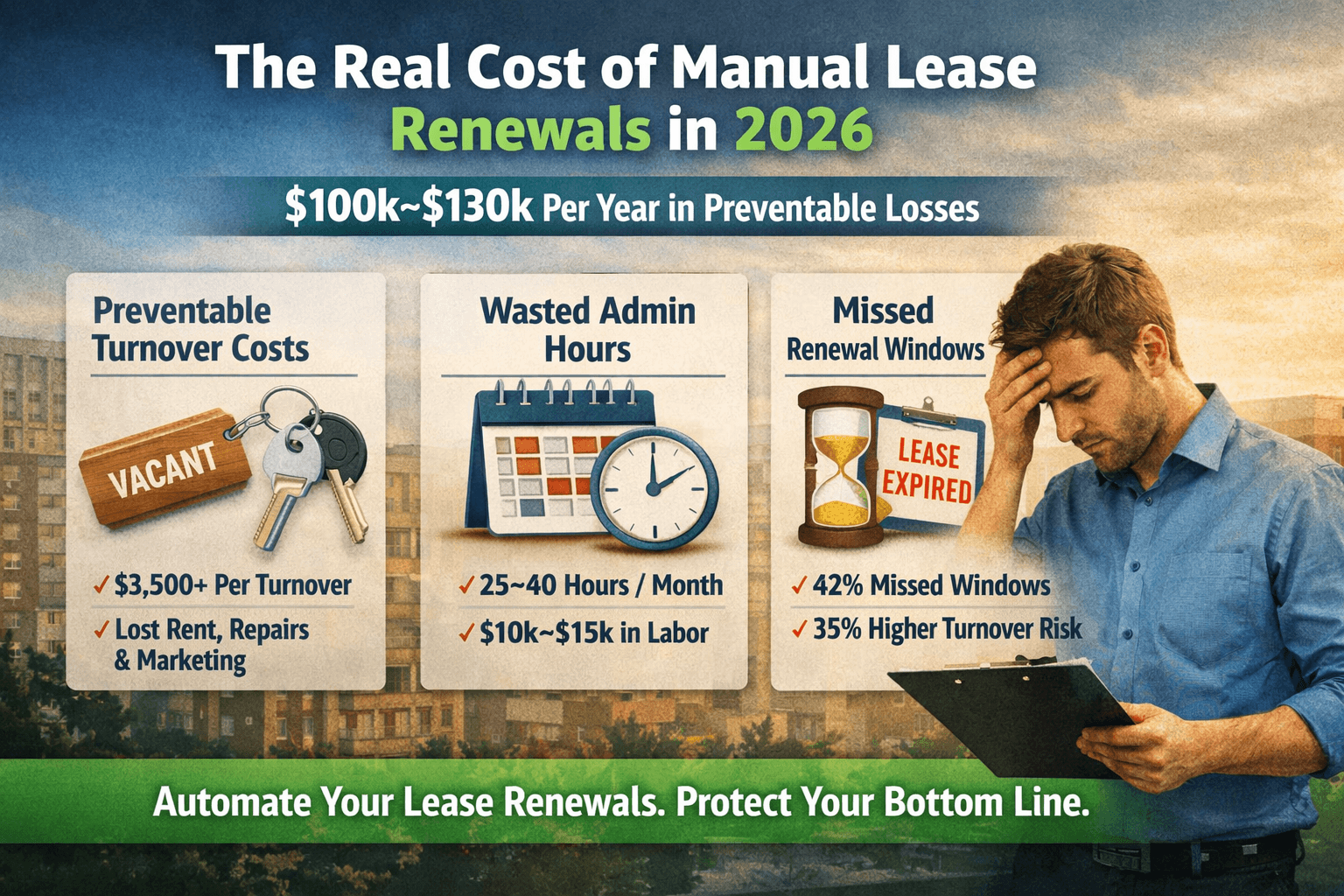
A clean renewal runs 30 minutes per door. A friction-loaded renewal runs 60-90 minutes. The average across a portfolio sits around 45 minutes per door per renewal cycle. On a 300-door portfolio with 12-month leases, that is 225 hours of property-manager time per year just on renewal procedural touches. At a $60-70 per hour loaded property-manager rate, the cost lands at $13K-$16K per year on the procedural side alone.
The procedural cost is the easy number to calculate. The hidden costs are larger. Non-renewals that happened because the renewal touchpoint slipped past a critical window. Renewals at below-market rates because the property manager did not have time to verify comparables before quoting. Renewals signed with last-minute paperwork friction that the tenant remembers as "they always make this hard." Each of these is invisible on a quarterly report and material at the year-end portfolio review. Adjacent service-business analysis documents the same hidden-cost pattern across appointment-and-renewal-driven service industries.
The 90-60-30 cadence that compresses non-renewals
The cadence that works for mid-market PM operators in 2026 is narrow and timing-specific.
90 days out: lease-end notice with rate context. Friendly message naming the renewal date, the current rate, an indication of market direction (you do not need to quote the rate yet; you do need to set expectations). One-click "yes, I want to renew" path for tenants ready to commit immediately.
60 days out: formal renewal offer. Specific rate, specific term options (12, 18, 24 months if applicable), one-click acceptance. Tenants who accept here lock the operator's revenue for the next year and reduce the back-half coordination cost to zero. Most well-priced renewals get accepted at the 60-day mark.
30 days out: final reminder with options. For tenants who have not yet responded, surface the choice clearly: renew at the offered rate, request a conversation about terms, or notice. The 30-day mark is the last clean window for either the operator or the tenant to make a decision without legal-notice complications.
Beyond 30 days the renewal moment compresses into uncomfortable conversations. The cadence that prevents the compression is the cadence that handles renewals while there is still room for both sides to make a decision calmly. Customer service automation engagements at PM clients use this exact pattern and report renewal rates 15-25 percentage points higher than the prior-year baseline.
The four most common renewal failure modes
1. The 30-day surprise. The property manager remembers the renewal at 30 days out. The tenant gets a rushed conversation that feels like the operator does not care enough to plan ahead. Renewal rate drops on this cohort by 8-15 percentage points compared to tenants on the 90-60-30 cadence.
2. The rate-quote-too-early trap. The operator quotes a rate at 90 days based on stale comps. The tenant accepts; the rate locks below current market. The owner sees lost revenue at year-end. Quote the rate at 60 days, not 90, with current comps.
3. The signature-follow-up black hole. Tenant agrees to renew verbally at 60 days. The paperwork goes out at day 55. The tenant sets it aside intending to sign over the weekend. Day 40 arrives with the document unsigned. The property manager realizes at day 25, panics, and chases. Build the AI signature-reminder cadence; do not rely on the tenant's memory.
4. The rate-negotiation-via-text trap. The tenant pushes back on the rate via SMS. The property manager responds via SMS at 9:30 pm. The conversation devolves into a written negotiation that should have been a 15-minute phone call. The AI's job is to recognize the rate-pushback pattern and route the conversation to a scheduled call rather than a text exchange.
What 2026 data shows on renewal economics
- Industry analysis on response-gap economics: communication friction at high-stakes moments produces the bulk of avoidable churn in property and other service businesses. Renewal is the highest-stakes moment in the PM annual cycle. Source.
- Salesforce on AI in customer service: the AI features delivering durable value sit at the procedural-cadence layer; renewal coordination fits cleanly. Source.
- Forrester on chatbot business case: AI deployments lacking documented baselines fail at renewal. Renewal automation specifically must measure renewal-rate, time-to-signature, and rate progression versus market. Source.
- Kustomer on AI triage: triage discipline routes the rate-negotiation conversations to humans. Pure procedural touchpoints stay with the AI. Source.
- Zendesk on ticket deflection: deflection counts when it resolves. A 90-day-out notice that did not yield a 60-day response is not a successful deflection; it is an open task that needs the next touch. Source.
- McKinsey 2025 State of AI: value capture concentrates in operators who rewire workflows around AI. Renewal coordination is a clean candidate for the rewire pattern because the timing requirements are precise. Report PDF.
- Gartner April 2026: AI projects stall without baselines; renewal automation must ship with measured baselines on renewal rate by portfolio segment. Source.
- RAND on AI deployment risk: misalignment between capability and business problem is the consistent failure root cause. Renewal automation that asks AI to negotiate rates hits this misalignment. Source.
The 30-day implementation shape we run at Hexa
At Hexa AI Agency we run the same shape when a PM operator asks us to scope renewal automation through AI workflow automation. Across the engagements we have shipped, the operators that compressed non-renewals followed this order.
Week 1: lock the baseline. Pull 18 months of renewal data from the PMS. Measure renewal rate by portfolio segment, time-from-notice-to-signature, current rate progression versus local market comps, and procedural property-manager hours per renewal. Document the attribution formula.
Week 2: build the 90-60-30 cadence. Configure the AI for PMS integration, communication channels, rate-context logic against market comps, escalation rules for rate-negotiation conversations, and signature-follow-up cadence. Pilot on one portfolio first.
Week 3: launch on the pilot portfolio. Run the cadence end to end. Watch renewal-acceptance rate at the 60-day mark, time-to-signature, and tenant sentiment in parallel.
Week 4: measure and decide. If renewal acceptance at 60-day climbed by 15+ percentage points and procedural PM hours dropped at least 50%, roll the pattern across the portfolio. If sentiment dropped, the tone or escalation logic needs tightening.
Budget realistically. A PM-focused renewal automation build lands in the $8K-$20K range one-time, plus $400-$1,000 per month for the AI usage on top of your existing PMS subscription.
Frequently asked questions
What renewal rate should I target in 2026?
Top-performing PM operators in stable markets hit 75-85% lease renewals on residential portfolios. Below 65% indicates either rate-pricing problems, tenant-experience problems, or renewal-cadence problems. Audit the cohort that did not renew to identify which root cause is largest before deploying technology against the symptom.
How much does PM renewal automation cost in 2026?
$8,000-$20,000 one-time for an integrated build with your existing PMS, plus $400-$1,000 per month for the AI usage. The cost is materially smaller than the revenue impact of even a 5-percentage-point lift in renewal rate on a 200+ door portfolio.
Will AI renewal automation feel impersonal to tenants?
Not if the procedural touchpoints are configured with the operator's tone and the rate negotiation is routed to a human. Tenants typically appreciate predictable 90-60-30 timing; they do not want last-minute rate conversations any more than the property manager does.
When is renewal automation the wrong investment for a PM operator?
When the portfolio is small (under 80 doors per renewal year), when the PMS does not expose lease-end data via API, or when the leadership team has not aligned on which conversations stay with humans. Document the routing rules first; automate the procedural layer second.
If you are evaluating a PM renewal automation build and want a second opinion on the scope, book a call at cal.com/hexaiagency and we will read the proposal with you, free. We do this often for operators running AI agent development across renewal, rent communication, maintenance, and follow-up under a single integrated build.
One closing operational reality. Operators who fix renewal first usually discover that the entire annual operating rhythm of the portfolio improves once the renewal moment is handled cleanly. Tenants who renewed on a calm 60-day cycle pay rent more consistently the next year. Vendors who saw the operator handle renewal communication professionally are easier to negotiate with the next year. Owners who saw the rate progression captured in writing renew their management contract more readily. The renewal moment is small in calendar weight and disproportionately large in downstream operational consequence.
The closing strategic point. Most PM operators view renewal automation as a back-office workflow optimization. The honest framing is that renewal is the moment where the property manager actually negotiates the next year of revenue per door. Treating it as a back-office task understates its commercial importance. The AI's job is to give the property manager more time and better data for the rate conversation, not to absorb the rate conversation itself.