
8 min readUpdated
AI Recall Systems: Recover $400K-$800K in Dental Production (2026)
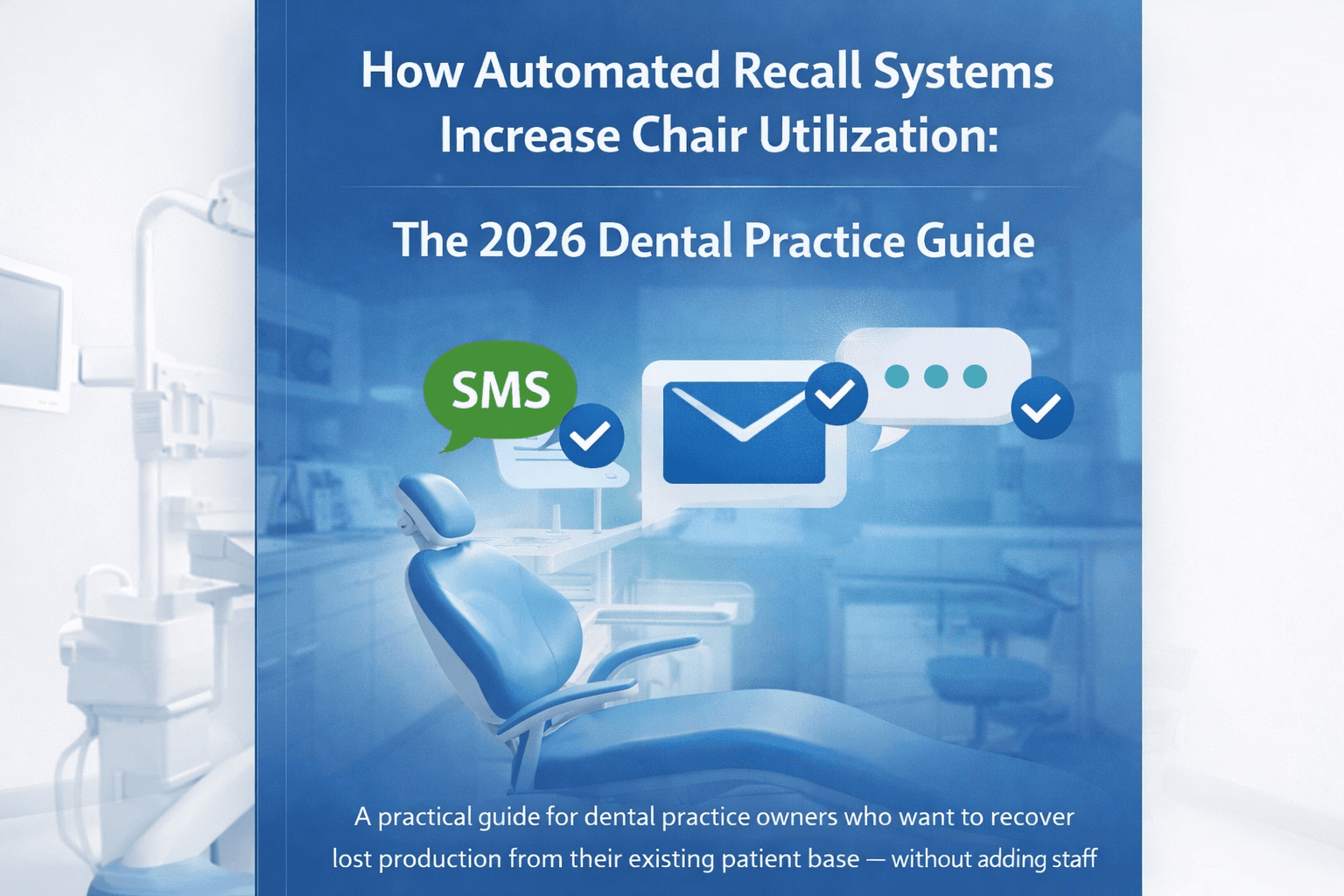
The recall math nobody calculates: 25-40% of active patients are unbooked. AI recall automation across four categories lifts chair utilization 10-25%.

Mike
Founder & AI Automation Lead
Every dental practice has a recall list. Every dental practice underuses it. The 6-month hygiene recall, the 1-year exam recall, the post-treatment follow-up recall, the lapsed-patient reactivation recall. Each list represents existing patients who have not booked their next appointment. Each unbooked appointment represents specific dollars of production the practice was already entitled to collect. The structural revenue inside the recall list is usually larger than any new-patient acquisition the practice is currently chasing, and it sits there quietly while marketing budget gets spent on cold prospects.
This post lays out the recall math nobody calculates, the four recall categories that drive chair utilization, the AI-assisted recall pattern that recovers booked appointments at scale, and the 30-day implementation we run at healthcare clients when chair utilization is the visible operational lever.
Key takeaways
- The recall list at a typical dental practice contains 20-40% of active patients who have not booked their next appointment. The dollar value is usually larger than the current new-patient pipeline.
- Four categories drive chair utilization: hygiene recall, exam recall, post-treatment follow-up, and lapsed-patient reactivation. Each has a different cadence and a different conversion-to-booked-appointment rate.
- AI absorbs the recall outreach across all four categories at consistency the front desk cannot match. The practice's chair utilization climbs 10-25% without adding staff.
- The discipline is rewiring the front-desk workflow around recall rather than treating recall as a "if we have time" task. Operators who keep recall as a side task get recall results as a side outcome.
The recall math nobody calculates
Take a 4-chair practice with 2,500 active patients. The 6-month hygiene recall pattern means roughly 5,000 hygiene appointments should be on the calendar over the next 12 months at this volume. In practice, most mid-size dental operations book about 60-75% of theoretically available hygiene appointments. The remaining 25-40% is the recall gap. On a $200 average hygiene visit including ancillary production, that gap represents $250K-$400K in annual revenue the practice was entitled to collect and did not.
The exam, post-treatment, and lapsed-patient categories add similar amounts. Across all four categories, the typical mid-market practice is leaving $400K-$800K in annual production unbooked. The practice is also, separately, spending 5-10% of revenue on new-patient marketing while sitting on an existing-patient recall list with a much higher conversion rate than any cold-marketing channel produces.
Nobody calculates this math because the recall gap is invisible by default. The PMS knows the patients due for recall, but the front desk does not have time to chase them all systematically. The gap shows up in chair utilization that runs 70-80% instead of the 90%+ that recall-disciplined practices hit.
The other reason the recall math stays hidden is that practice owners tend to associate "growth" with new-patient acquisition. The marketing budget reflects this. The cost to acquire a new dental patient through paid channels in 2026 sits in the $150-$400 range depending on market, while the cost to reactivate an existing recall-list patient through an AI outreach sequence sits closer to $2-$5. The unit economics are not subtle. Practice owners who internalize this comparison shift budget from cold acquisition to recall recovery; practice owners who do not, continue spending five-figures monthly on new patients while a six-figure recall list sits unchased.
A second source of invisibility is the way most PMS recall reports are designed. They show patients due for recall in the next 30 days, which feels manageable. They do not show the cumulative unbooked count across the last 24 months, which is the number that actually matters. Operators who run the cumulative report once usually discover their recall gap is two or three times larger than they thought.
The four recall categories that drive chair utilization
1. Hygiene recall (6 months). The highest-volume category. Patients who completed a hygiene visit and are now due for the next one. AI cadence: outreach at month 5, month 5.5, month 6. Most practices recover 30-50% of currently-lapsed hygiene recalls within the first 90 days of deployment.
2. Exam recall (12 months). Patients due for a comprehensive exam. Lower volume but higher per-visit value. AI cadence: outreach at month 11, month 11.5, month 12.
3. Post-treatment follow-up (variable cadence by procedure). Patients with a specific clinical need at a specific window. Crown placement check at 2 weeks, ortho check at 6 weeks, periodontal maintenance at 3-4 months. The clinical specifics determine the cadence; the AI handles the timing.
4. Lapsed-patient reactivation (12-24 months since last visit). The hardest category and the highest upside. Patients who fell off the recall list, often because life intervened. AI outreach at 14, 18, and 24 months with a re-engagement message and one-click booking. Typical reactivation rate is 8-15% on previously-lapsed patients, which is materially higher than cold-marketing conversion.
Customer service automation engagements at dental clients consistently see chair utilization climb 10-25% within six months when all four categories are deployed in parallel.
The cadence question deserves its own paragraph because most recall builds get it wrong. The reflexive instinct is to send recall outreach the day a patient becomes due. The data is clear that the right timing is two to four weeks before the due date. Patients who get a reminder while they still have flexibility to book convert at materially higher rates than patients who get one after the due date when they feel mildly behind. The AI's job is to know the exact patient-level due window and start outreach inside the right pre-window. Most PMS recall reports default to past-due timing; configure the AI to lead, not chase.
The channel question also matters more than vendors usually acknowledge. Hygiene recall converts best on SMS for most patient populations under 60 and on email for most over-60 populations. Exam recall does well on email because the longer window makes the email format appropriate. Post-treatment follow-up is best on the channel the patient used at booking. Lapsed-patient reactivation is best on a mix of channels because the patient may have changed phone numbers or stopped checking the email on file. The AI handles the channel logic; the practice does not have to think about it after configuration.
What 2026 data shows on recall and patient retention
- Industry analysis on appointment communication and patient retention: recall gaps drive the bulk of avoidable revenue loss in dental practices; structural fixes consistently outperform marketing investment for the same operational result. Parallel service-business analysis.
- Salesforce on AI in customer service: AI's durable value sits at the procedural-cadence layer; recall is exactly this layer. Source.
- Forrester on chatbot business case: AI deployments that fail at renewal lack documented baselines. Recall automation has to ship with current chair-utilization and recall-completion baselines. Source.
- Kustomer on AI triage: triage discipline applies to recall too. The lapsed-patient category often surfaces clinical concerns that should route to a clinician rather than booking directly. Source.
- Zendesk on ticket deflection: deflection counts when it resolves. Recall outreach that did not convert to booking is not "completed"; it is an open task in the AI's queue for the next touchpoint. Source.
- McKinsey 2025 State of AI: value capture concentrates in operators who rewire workflows around AI. Dental practices that restructure the front-desk role around recall capture more value than ones treating recall as a side task. Report PDF.
- Gartner April 2026: AI projects stalling without baselines is the consistent pattern; dental recall automation has to ship with measured baselines. Source.
- RAND on AI deployment risk: the consistent failure root cause is misalignment between AI capability and business problem. Recall is one of the cleanest fits for AI; the misalignment risk is low if the scope is documented. Source.
The 30-day implementation shape we run at Hexa
At Hexa AI Agency we run the same shape when a dental practice asks us to scope recall automation through AI workflow automation. Across the engagements we have shipped, the practices that recovered the most production followed this order.
Week 1: lock the baseline. Pull the recall report from the PMS (Dentrix, Eaglesoft, Open Dental, Curve, etc.). Count active patients by recall category. Calculate the recall gap (overdue, never-followed-up, lapsed). Calculate the dollar value at average per-visit production. Sign off on the attribution formula.
Week 2: build the four-category outreach. Configure the AI for PMS integration, recall cadence rules per category, communication channels (SMS preferred for hygiene, email for exam, mixed for follow-up, persistent for lapsed-reactivation), and clinical-routing rules.
Week 3: launch on one category. Start with hygiene recall (highest volume, cleanest patterns). Watch booking rate, response rate, and patient sentiment in parallel. Compare against baseline.
Week 4: measure and decide. If hygiene recall booking lifted at least 25% over baseline and sentiment held, expand to exam recall next, then post-treatment follow-up, then lapsed reactivation. If sentiment dropped, the tone needs tightening before expanding.
Budget realistically. A dental recall automation build lands in the $6K-$15K range one-time, plus $300-$600 per month for the AI usage on top of your existing PMS. Most practices see net-positive ROI inside the first 60 days from recovered hygiene bookings alone.
Frequently asked questions
What chair utilization rate should a dental practice target in 2026?
90%+ on hygiene chairs is achievable with disciplined recall automation. Doctor chairs vary by case mix but should sit above 75-80%. Practices running below these thresholds typically have recall gaps, not new-patient gaps; the fix is recall discipline before marketing spend.
How much does dental recall automation cost in 2026?
$6,000-$15,000 one-time for an integrated build with your existing PMS, plus $300-$600 per month for the AI usage. The cost is far smaller than the production recovered in the first quarter for any practice with active recall gaps.
Will AI recall outreach feel impersonal to patients?
Not if the tone matches the practice's voice and the AI routes clinical concerns to the team. Patients typically appreciate the reminder; they have not booked because they forgot, not because they did not want to. The AI removes the friction that prevented the booking.
When is dental recall automation the wrong investment?
When the practice has a small active-patient list (under 500), when the PMS does not expose recall data via API, or when the leadership team has not aligned on which recall categories the AI handles versus which the front desk owns. Document the recall ownership split first; automate the procedural side second once the front-desk team understands which categories they continue to own personally.
If you are evaluating a dental recall automation build and want a second opinion on the scope, book a call at cal.com/hexaiagency and we will read the proposal with you, free. We do this often for practices running AI agent development engagements that combine recall, no-show prevention, and intake under a single AI layer rather than three separate point solutions that drift out of sync over time.