
8 min readUpdated
Why Self-Storage Loses Move-In Calls (and the AI Fix)
Self-storage operators lose 30-40% of qualified move-in calls to after-hours and busy office windows. The voice AI pattern that recovers most of them.

Mike
Founder & AI Automation Lead
A self-storage facility's most expensive failure mode is the inbound call that does not get answered. A prospect picks up the phone because they are mid-decision: a move, a downsize, a life event has produced a need for storage space within the next two weeks. They call three facilities in their area. The first one to answer with a useful conversation typically wins the lease. The other two never know they were in the running. Self-storage operators in 2026 are losing a quarter to two-thirds of their inbound calls to voicemail and to closed-office hours, and the operational cost is invisible until somebody calculates the lifetime value of the leases that walked.
This post lays out where storage operators actually lose calls in 2026, the AI voice agent pattern that recovers most of them, the four scenarios where the AI should hand off to a human, and the 30-day implementation we run when scoping voice automation for self-storage operators.
Key takeaways
- Self-storage facilities miss a large share of inbound move-in calls during after-hours and busy office windows. The lost calls are usually qualified prospects who picked up the phone in a buying mindset.
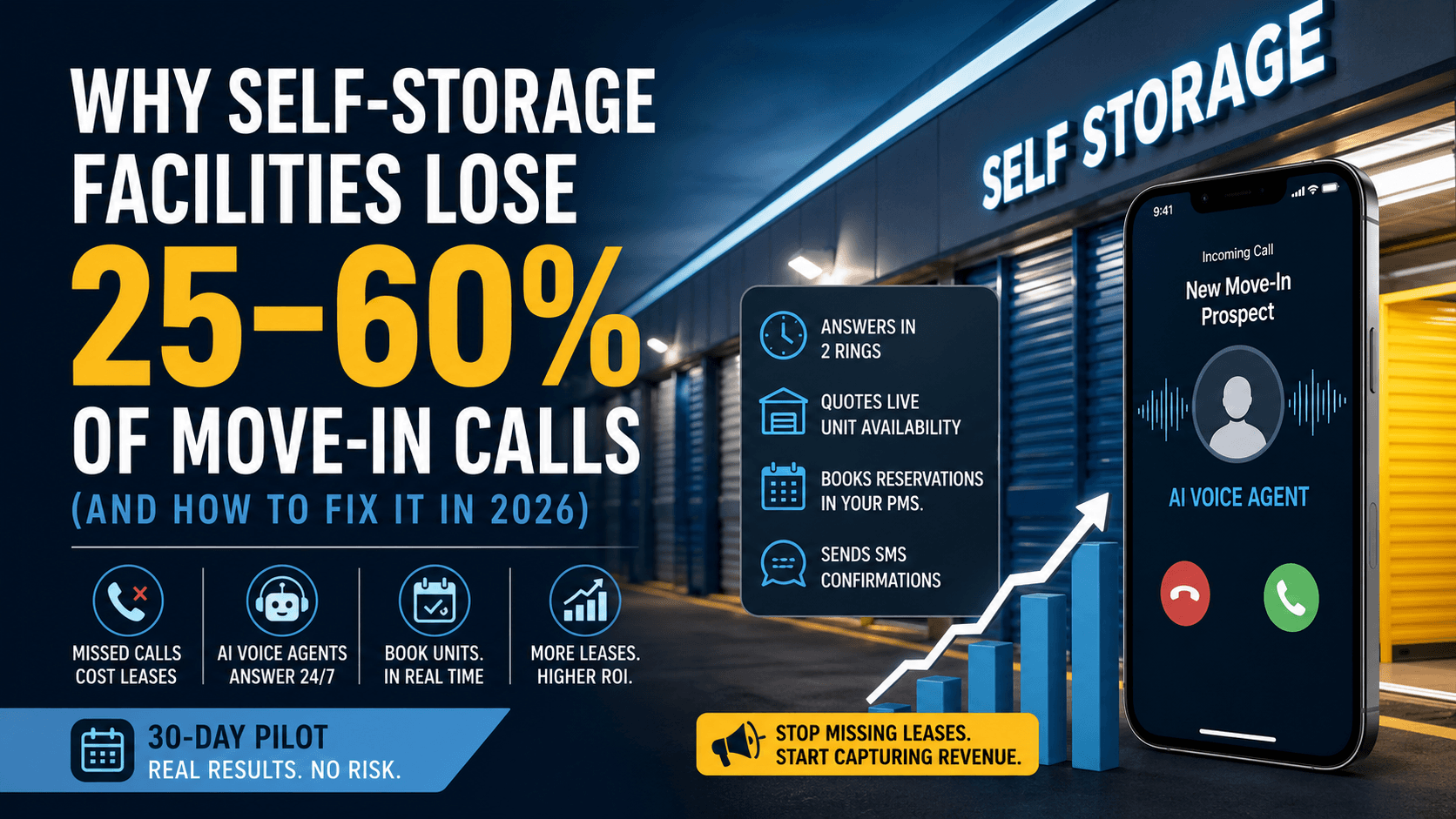
- AI voice agents in 2026 can answer in two rings 24/7, quote a unit by size and climate, qualify the prospect, and book the reservation directly into the PMS. Operators recover the after-hours leads they used to lose.
- Bolt the voice AI onto your existing PMS (SiteLink, Storable, storEDGE) rather than rebuilding the storage stack. The migration trap kills more storage AI projects than it should.
- Track three metrics: answer rate (target 95%+), book rate on qualified calls, and after-hours lead capture. If any of the three is not measurable in your current setup, instrument first.
Where storage operators actually lose calls
Two structural windows drive most of the lost-call volume at a typical mid-market self-storage operator. The first is after-hours: the office closes at 5pm or 6pm; prospects calling between 6pm and 9am hit voicemail or no answer at all. Industry research consistently shows that 30-40% of qualified storage inbound arrives outside business hours, and that prospects who hit voicemail rarely leave a message and rarely call back. The second window is during busy office hours: the on-site manager is helping a walk-in customer, processing a payment, or doing a unit inspection, and the phone rings unanswered.
The cost compounds because storage prospects are time-sensitive. The same prospect who called your facility at 7pm Wednesday is going to call your competitor at 7:05pm Wednesday. By Thursday morning when your on-site manager checks voicemail, the prospect has already toured a competing facility and is mid-lease. The lost call did not represent a single missed lease; it represented the customer relationship for the next 12-24 months of average tenancy.
Parallel service-business analysis on response gaps documents the same pattern. The lever is structural answering capacity rather than improved sales technique on the calls that do get answered.
The AI voice agent pattern that recovers move-in calls
The voice agent shape that works for self-storage operators with 100-1,000 units per facility in 2026 has four functional layers.
Layer 1: answer in two rings, 24/7. The AI answers every inbound call regardless of time. The prospect hears a natural conversational greeting, not a menu tree.
Layer 2: structured qualification. The AI captures the data needed to quote a unit: move-in date, what is being stored, vehicle or item size if applicable, climate control requirement, expected tenancy length. The qualification takes 60-90 seconds and feels like a conversation rather than an interrogation.
Layer 3: unit lookup and quote. The AI queries the PMS in real time for available units matching the prospect's criteria, quotes a price, offers a reservation. The prospect can lock the unit on the call before hanging up.
Layer 4: PMS booking with SMS confirmation. The reservation lands in the PMS automatically. The prospect receives an SMS confirmation with the unit details and the access instructions for move-in day. Customer service automation engagements at self-storage operators use this exact pattern.
The four layers together replace the voicemail-and-callback shape with a single in-call resolution. Industry-wide answer rates climb from 40-65% to 95%+ in deployments that include the after-hours window.
What 2026 data shows on storage answer rate and missed-call economics
- Industry analysis on missed-call economics: small-business missed-call rates run 25-60% across service industries, with self-storage typically in the higher end of that range due to after-hours demand. Parallel service-business analysis.
- Salesforce on AI in customer service: voice AI has matured into a production-ready category in 2026 for procedural workflows like quoting and booking. Source.
- Forrester on chatbot business case: AI deployments lacking documented baselines fail at renewal; storage voice AI must measure answer rate, book rate, and after-hours capture as core baselines. Source.
- Kustomer on AI triage: triage discipline applies to voice. Procedural quoting goes to the AI; complex situations (billing disputes, lockouts, complaints) route to humans. Source.
- McKinsey 2025 State of AI: value capture concentrates in operators who rewire workflows around AI. Storage operators that consolidate the move-in funnel around the voice agent capture more value than ones bolting voice onto an unchanged process. Report PDF.
- Gartner April 2026: AI projects stalling without baselines is the consistent pattern; storage voice AI is no exception. Source.
- RAND on AI deployment risk: misalignment between capability and business problem is the consistent failure root cause. Voice AI fits well for procedural quoting; misaligns when asked to handle dispute resolution. Source.
- Anthropic on production AI patterns: structured-output discipline matters for voice deployments because the output has to feed cleanly into the PMS. Source.
The four scenarios where the AI should hand off to a human
1. Billing disputes or charges the customer does not recognize. The AI can summarize the charge from the PMS but should not be defending it. Route to the on-site manager or billing team during business hours; route to a documented after-hours escalation otherwise.
2. Lockouts or after-hours access issues. Customers locked out of their unit or having gate-access problems need a human. The AI's job is to recognize the situation, escalate immediately, and reassure the customer that help is on the way.
3. Move-out negotiations. A customer who wants to move out unexpectedly is often negotiable if the operator engages thoughtfully. The AI captures the request and routes to the on-site manager; the manager calls back within a defined window.
4. Anger or distress in voice tone. Voice AI models can detect frustration patterns. Configure the agent to hand off whenever the conversation tone shifts. The AI handling an angry customer with a procedural response produces the worst version of the interaction.
The 30-day implementation shape we run at Hexa
At Hexa AI Agency we run the same shape when a self-storage operator asks us to scope voice automation through AI agent development. Across the engagements we have shipped, the operators that recovered the most leases followed this order.
Week 1: lock the baseline. Pull 90 days of phone-log data from the office system. Measure four numbers: answer rate during business hours, after-hours call volume, voicemail-to-callback rate, and current move-in lead conversion. Document the attribution formula tied to average tenant LTV.
Week 2: build the voice agent. Configure the AI for the operator's PMS integration (SiteLink, Storable, storEDGE), unit-quoting logic, qualification script, and handoff rules. Pilot on one facility first.
Week 3: launch on after-hours traffic. Route only after-hours and weekend calls through the AI initially. Watch answer rate, book rate, and customer satisfaction signals in parallel. Compare against baseline.
Week 4: measure and decide. If answer rate hit 95%+ on after-hours, book rate on qualified calls held at 30%+, and customer sentiment remained neutral or positive, expand to business-hours coverage for during-office-busy moments. If sentiment dropped, the AI tone or handoff logic needs tightening.
Budget realistically. A self-storage voice AI build lands in the $5K-$15K range one-time, plus $300-$900 per month for the voice and AI usage on top of your existing PMS subscription. Operators with after-hours leakage typically see net-positive ROI inside the first 60-90 days.
Frequently asked questions
What answer rate should a self-storage operator target?
95%+ on all inbound calls (including after-hours) is achievable in 2026 with voice AI in front of the PMS. The 5% gap accounts for edge cases that route to humans during legitimately unavailable windows. Operators currently sitting in the 40-65% answer range are leaving significant lease revenue on the table.
How much does self-storage voice AI cost in 2026?
$5,000-$15,000 one-time for an integrated build with your existing PMS, plus $300-$900 per month for the voice and AI usage. The cost compares favorably against missed-lease LTV; even a handful of recovered leases per month pays back the monthly cost.
Will customers know they are talking to AI?
Yes, and the build should disclose this clearly. The honest framing ("Hi, I am the virtual assistant for [facility]; I can help with unit availability, reservations, and basic questions") performs better than attempting to pass as human and being discovered. Customers in 2026 accept AI interactions when the AI handles the procedural task well.
When is voice AI the wrong investment for a storage operator?
When the facility is very small (under 100 units), when the PMS does not expose unit data via API, or when the operator has not yet measured the missed-call rate. The 30-day pilot is cheap; running the pilot without baseline measurement is what wastes the spend.
If you are evaluating a self-storage voice AI build and want a second opinion on the scope, book a call at cal.com/hexaiagency and we will read the proposal with you, free. We do this often for operators running AI workflow automation across move-in, billing, and tenant communication from a single integration layer.
One closing operational reality. Self-storage operators that deploy voice AI for after-hours coverage often discover that the recovered leads have systematically different characteristics from the leads captured during business hours. After-hours callers are typically further along in the decision process, have stricter timing constraints, and convert at higher rates per qualified call. The cohort the operator was missing was disproportionately the cohort with the highest urgency and the highest willingness to lock the unit on first contact. Recovering those leads compounds beyond the simple math of "answer rate up x%."
The closing strategic point. The self-storage industry has historically competed on physical location, pricing, and security features. The 2026 competitive landscape adds a fourth dimension: response speed. Operators who answer in two rings 24/7 will capture lead share from operators who answer when they can. The voice AI investment is not just operational efficiency; it is a competitive moat that compounds across quarters because the lead-share gap is hard for slower competitors to close once it opens at any meaningful scale.