
8 min readUpdated
AI Roofing Estimating: Cut Sales Cycle 21 to 7 Days (2026)
Why first-quote wins in residential roofing, the four AI workflows that compress lead-to-proposal time, and the 30-day shape that produces durable ROI.

Mike
Founder & AI Automation Lead
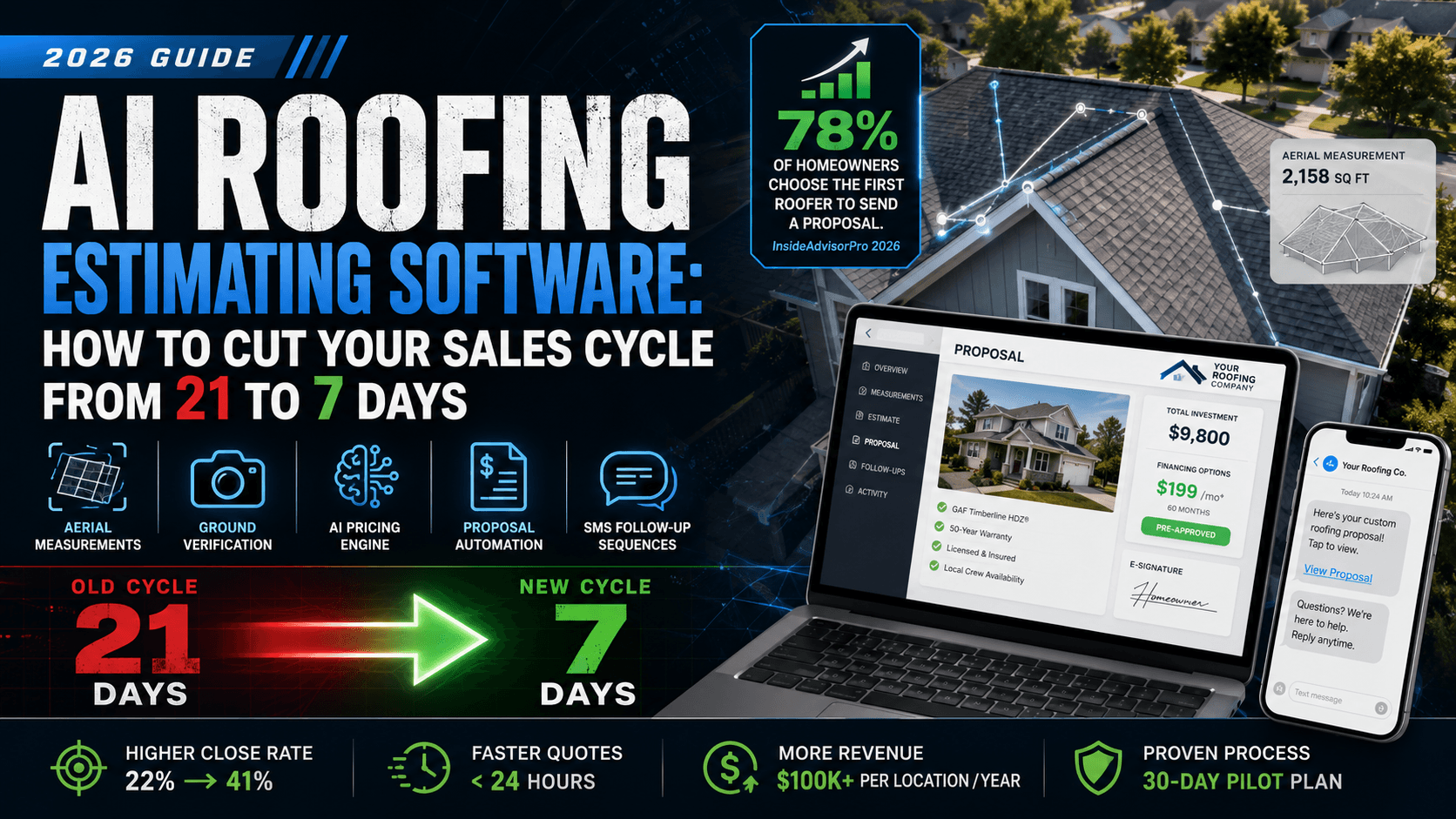
A roofing contractor in 2026 is competing on speed more than any other dimension. The first-quote-wins dynamic is well documented in residential roofing: most homeowners go with the first contractor to deliver a real proposal, not the lowest priced or the highest reviewed. The sales-cycle math is unforgiving. A contractor whose lead-to-proposal time runs 21 days loses to a contractor whose lead-to-proposal time runs 6 days, regardless of any other competitive factor. AI estimating software is the lever that compresses that gap, and the contractors who deploy it well in 2026 are pulling ahead of competitors who think pricing and reviews are still the deciding inputs.
This post lays out how AI roofing estimating actually works in 2026, the four workflows that compress the sales cycle, the four traps that produce overstated savings, and the 30-day implementation we run when scoping roofing AI builds at contracting clients.
Key takeaways
- AI roofing estimating compresses lead-to-proposal time from 18-25 days (industry average) to under 7 days in well-scoped deployments. The compression compounds because first-quote-delivered contractors win the lease far more often than later contractors.
- The four workflows that pay back: AI aerial measurement ingestion, AI estimate generation, automated proposal delivery, and SMS follow-up sequences. Each can be deployed independently; combined they compound.
- Bolt AI onto the existing roofing stack (AccuLynx, JobNimbus, Roofr, plus aerial providers like EagleView or Hover). Switching CRMs to get AI features rarely pays back.
- The leading indicator is "time from first call to proposal sent." Anything over 48 hours is leaving leads on the table for faster competitors.
Why first-quote wins in residential roofing
A homeowner who decides they need a new roof is mid-decision under stress. They make three or four phone calls in a single afternoon, schedule one or two inspections that week, and sign with whichever contractor produces a clear written proposal first. The dynamic does not reward quality differentiation as much as roofers would prefer; it rewards speed of clarity. The contractor who turns a Tuesday call into a Wednesday proposal at 4pm wins the bid before the third inspection has even happened.
The math compounds across the operation. A contractor running a 21-day average sales cycle is competing against contractors running 7-day cycles. The slower contractor's marketing spend has to make up for the lost-to-speed gap in close rate. The faster contractor wins the same number of customers on less marketing spend. The compounding favors the speed leader at every step of the operation.
Adjacent service-business analysis on response-time dynamics documents the same pattern across home-services categories. Roofing is on the more extreme end because the decision urgency is high and the homeowner has fewer reference points to compare on dimensions other than speed.
The four AI workflows that compress the roofing sales cycle
1. AI aerial measurement ingestion. The AI ingests aerial reports from EagleView, Hover, or GAF QuickMeasure and extracts the relevant measurements (squares, pitch, valleys, ridges, hips). The 30-45 minute manual data-entry step disappears. The estimator moves directly to pricing rather than transcribing.
2. AI estimate generation. The AI applies the contractor's pricing logic (material costs, labor rates, multipliers for pitch, complexity, accessibility) to the measurements and produces a draft estimate. A senior estimator reviews and adjusts rather than building from scratch. Estimate generation time drops from hours to minutes.
3. Automated proposal delivery. The AI generates the proposal document (estimate, scope, terms, financing options, scheduling preview) and delivers it via the contractor's preferred channel. The proposal reaches the homeowner within 24 hours of the first inspection rather than 3-7 days later.
4. SMS follow-up sequences. Most roofing deals close on touchpoint 3 or later. The AI handles the follow-up cadence (24 hours after proposal, 3 days, 7 days) without the sales team having to remember. Customer service automation engagements at contracting clients use the same cadence pattern.
What 2026 data shows on roofing sales speed and AI lift
- Industry analysis on response-time and contract win-rate dynamics: response-gap economics in home-services consistently identify first-touch speed as the dominant predictor of close rate. Source.
- Salesforce on AI in customer service: the AI features delivering durable value sit at the procedural-coordination layer; roofing estimate generation is a clean fit. Source.
- McKinsey 2025 State of AI: value capture concentrates in operators who rewire workflows around AI. Roofing operators redesigning the sales cycle around AI estimating capture more value than ones bolting AI onto unchanged processes. Report PDF.
- Forrester on chatbot business case: AI deployments lacking documented baselines fail at renewal. Roofing AI must measure lead-to-proposal time and proposal-to-close rate as core baselines. Source.
- Gartner April 2026: AI projects across IT and operations stall ahead of meaningful ROI without baselines; roofing AI is no exception. Source.
- BCG 2024 on GenAI bottom-line impact: the differentiator is operating-model change; roofing contractors who redesign the sales cycle around AI estimating compound the value over multiple quarters. Source.
- RAND on AI deployment risk: misalignment between capability and business problem is the consistent failure root cause. Roofing AI deployed for estimate generation fits well; deployed for close-decision automation hits the misalignment hard. Source.
- MIT NANDA 2025 analysis: 95% of corporate GenAI pilots produce zero measurable revenue impact. Roofing AI is in the 5% that work when scoped to procedural estimating with documented baselines. Source.
The four traps that produce overstated savings
Trap 1: relying only on aerial measurements. AI aerial ingestion is excellent on roof surface measurements and weak on decking condition, ventilation needs, and flashing details that require ground-level inspection. Trusting the aerial-only data without ground verification produces post-sale margin erosion on the cases that need rework.
Trap 2: generic AI proposals. The AI can write a proposal quickly. The proposals that close at higher rates are personalized to the neighborhood, the storm exposure, and the homeowner's stated priorities. AI personalization based on real client context lifts close rate; generic AI proposals lift speed without lifting close rate.
Trap 3: mixing insurance and retail workflows. Insurance jobs have different scopes, different documentation requirements, and different approval gates. Trying to run them through the retail estimate flow produces friction in both directions. Build separate workflows for the two motion types.
Trap 4: skipping the SMS follow-up sequence. Most roofing deals close on touch 3 or later. AI estimating that ships fast proposals but does not automate the follow-up loses to slower competitors who follow up consistently. The estimating speed is necessary; the follow-up discipline is what closes the bid.
The 30-day implementation shape we run at Hexa
At Hexa AI Agency we run the same shape when a roofing contractor asks us to scope AI estimating through AI workflow automation. Across the engagements we have shipped, the contractors that compressed sales cycles most aggressively followed this order.
Week 1: lock the baseline. Pull 90 days of sales-cycle data from the CRM (AccuLynx, JobNimbus, Roofr). Measure four numbers: lead-to-proposal time, proposal-to-close rate, average residential job value, and current close rate. Document the attribution formula tied to recovered deal volume.
Week 2: build the AI estimating layer. Configure the AI for aerial-provider integration (EagleView, Hover, or QuickMeasure), the contractor's pricing logic, proposal templates, and CRM integration. Pilot on one estimator first.
Week 3: launch on a portion of incoming leads. Route half of new leads through the AI estimating workflow; keep the other half on the manual workflow as a control. Watch time-to-proposal, close rate, and customer feedback in parallel.
Week 4: measure and decide. If time-to-proposal dropped below 48 hours on the AI cohort and close rate held flat or improved, roll the workflow to the full sales team. If close rate dropped despite the speed lift, the proposal quality needs tightening before expansion.
Budget realistically. A roofing-focused AI estimating build lands in the $5K-$15K range one-time, plus $300-$1,000 per month for the AI usage on top of your existing CRM and aerial-provider subscriptions. Most contractors see net-positive ROI inside the first 30-60 days from recovered closes alone.
Frequently asked questions
What lead-to-proposal time should a roofing contractor target?
Under 48 hours on residential leads is the 2026 competitive standard. Under 24 hours is achievable with disciplined AI estimating and is the threshold above which the speed advantage becomes durable across markets. Contractors stuck at 5+ days are losing deals to faster competitors regardless of any other factor.
How much does AI roofing estimating cost in 2026?
$5,000-$15,000 one-time for an integrated build with your existing CRM and aerial-provider stack, plus $300-$1,000 per month for the AI usage. The cost compares favorably against the deal volume recovered from speed alone; even a handful of additional residential closes per month covers the monthly cost.
Will AI estimating replace my senior estimator?
No. The AI absorbs the procedural measurement-and-pricing work. The senior estimator's role shifts toward higher-value tasks: complex repair scopes, insurance-claim coordination, customer relationship management, and the cases the AI flagged for human judgment. Headcount usually stays flat; output per estimator typically doubles.
When is AI roofing estimating the wrong investment?
When the contractor is very small (under 20 jobs per month), when the CRM does not integrate with aerial providers, or when the team has not yet measured today's lead-to-proposal time. Document the baseline first; deploy AI second.
If you are evaluating an AI roofing estimating build and want a second opinion on the scope, book a call at cal.com/hexaiagency and we will read the proposal with you, free. We do this often for contractors combining estimating with AI agent development on the inbound-lead-intake side, where the same data layer powers both the speed gain and the close-rate lift.
One closing operational reality. Roofing contractors who deploy AI estimating often discover that the speed lift produces a secondary benefit nobody quoted in the original ROI calculation: vendor and supplier relationships improve. Suppliers who get earlier purchase commitments based on faster sales close are more willing to hold inventory, offer better pricing, and prioritize the contractor's orders during peak season. The compounding crosses the original boundary of the sales workflow into procurement, which compounds further in margins.
The closing strategic point. The residential roofing market in 2026 has more inbound demand than most contractors can handle during peak season; the binding constraint is not lead volume but conversion-and-execution speed. Contractors who solve the speed constraint with AI estimating capture more of the existing demand without scaling marketing spend. The competitive landscape rewards the operational discipline rather than the marketing budget; AI estimating is one of the cleanest examples of that shift across the residential service industry in the next 12 to 24 months of operational evolution, and the contractors who internalize it earliest will compound an unassailable lead over slower regional competitors who continue to compete on price rather than on speed and overall customer experience in a market that has clearly shifted in favor of the speed leaders.