
8 min readUpdated
How to Improve Property Management Follow-Up in 2026
The seven follow-up moments owners and tenants expect you to remember, four common failure modes, and the AI workflow that closes the gaps at scale.

Mike
Founder & AI Automation Lead
Owners and tenants in property management rarely complain about the actual work. They complain about the follow-up. The repair eventually got done; nobody told them when. The rent question got resolved; the response came three days late. The lease renewal happened; the renewal conversation felt rushed because the property manager remembered it the day before the deadline. Property management follow-up discipline is what separates the operators who renew owner contracts and retain tenants from the ones that produce identical operational work and still lose both.
This post lays out the seven follow-up moments every owner and tenant expects you to remember in 2026, the four most common follow-up failure modes, the AI-assisted system that closes the gaps at scale, and the 30-day implementation shape we run at property management clients when the follow-up gap is the visible operational problem.
Key takeaways
- The seven follow-up moments: maintenance request acknowledgment, dispatch confirmation, completion notification, rent reminder, lease-renewal sequence, move-in/move-out coordination, and owner monthly update.
- Missing follow-up rarely shows up in a single quarter's numbers. It shows up at the next renewal conversation, in tenant reviews, and in the slow erosion of the property manager-owner relationship.
- AI absorbs the procedural follow-up at consistency the manual process cannot match. The property manager keeps the relationship moments and the high-judgment conversations.
- The audit trail is the proof of work. Without it, the property manager cannot defend operational decisions at the moment trust is being tested.
The seven moments owners and tenants expect you to remember
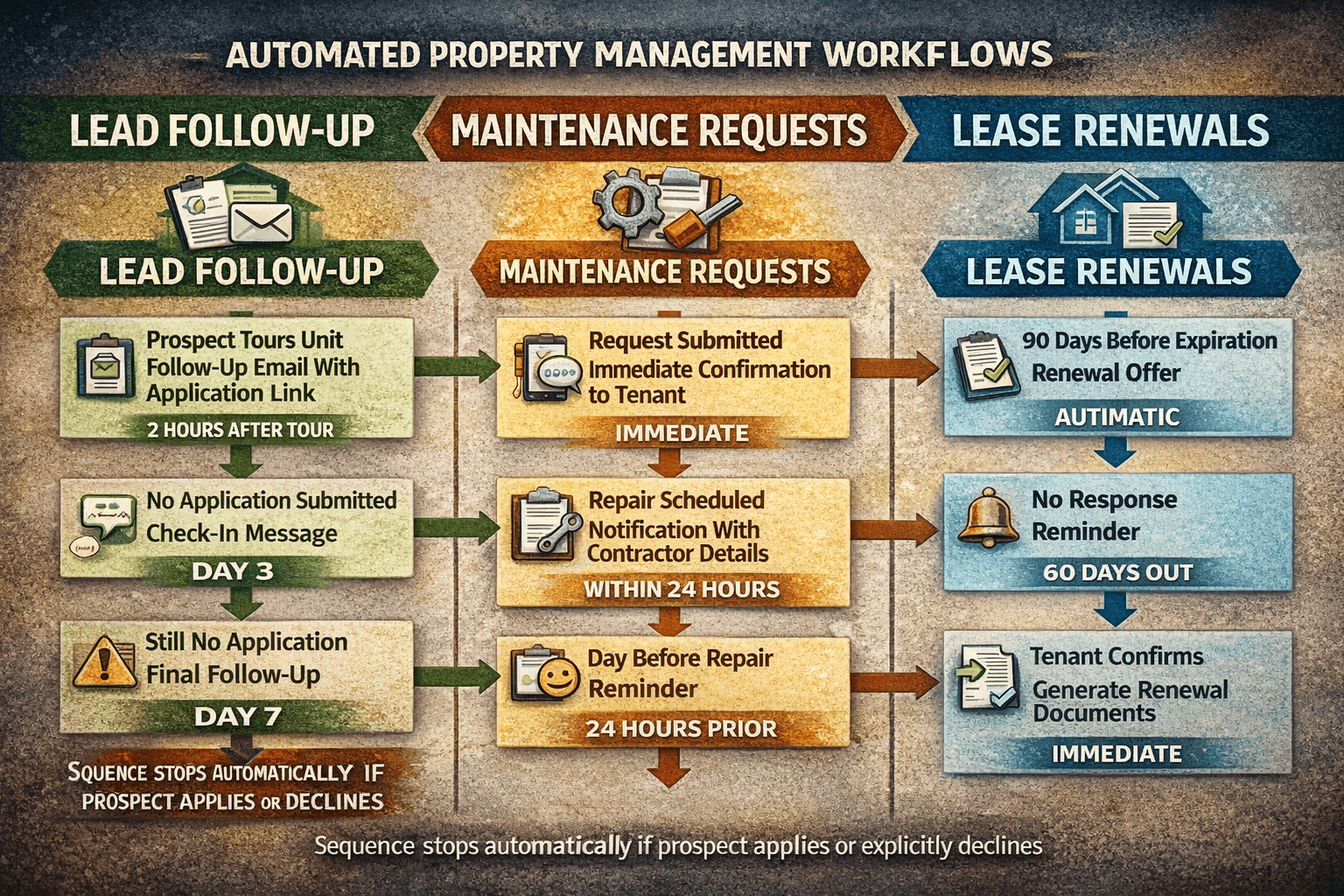
1. Maintenance request acknowledgment within 60 seconds. A tenant who submitted a maintenance ticket wants to know it was received. Not solved, not even triaged yet. Received. The acknowledgment moves the tenant's mental state from "did anyone see this" to "they are working on it." Operators who acknowledge in under a minute, even automatically, hold tenant patience materially longer than operators who acknowledge within the next business day.
2. Dispatch confirmation when the vendor is scheduled. The tenant wants to know when the work is happening. The window matters more than the exact time; "Wednesday between 9-12" beats "soon" by a significant margin. The vendor scheduling itself takes 30 seconds; the follow-up to the tenant takes another 30. Skipping the second 30 seconds is the failure mode.
3. Completion notification. Work-done acknowledgment to the tenant, plus PMS update, plus owner-side log entry. Most operators skip the owner-side log entry, which becomes a problem at owner review time.
4. Rent reminder sequence. The five-touch cadence (3 days before, day of, day after, day 3, day 7) catches forgetting, friction, and timing gaps before they become deeper delinquency. Customer service automation engagements at PM clients use this exact sequence.
5. Lease-renewal sequence. 90, 60, 30 days out. Each touch carries the renewal options and the rate context. Operators who follow the cadence consistently see renewal rates 15-25 points higher than operators who reach out at 14 days out.
6. Move-in / move-out coordination. Utility transfers, inspection scheduling, key handoff, security-deposit timing. Every step has a specific deadline; missing any of them costs trust at the worst possible moment in the tenant relationship.
7. Owner monthly update. Even when no incidents occurred. Owners notice the absence of communication more than they notice the substance of it. A short monthly update that nothing requires attention is much more reassuring than silence followed by an unexpected escalation.
The four most common follow-up failure modes
Failure 1: the inbox black hole. Tenant inbound lands in info@ or maintenance@. Three people check it occasionally; nobody owns it. Follow-up slips not from incompetence but from the standard failure mode of any shared inbox with no single owner. Parallel service-business analysis documents the same pattern.
Failure 2: the on-call rotation gap. Weekend and after-hours inbound waits until Monday morning. By then the tenant's problem has either resolved itself or escalated. Either outcome erodes trust without the operator noticing the missed window.
Failure 3: the "I'll handle it tomorrow" debt. The property manager sees the message, intends to follow up, and gets pulled into a more urgent task. Tomorrow becomes Friday becomes next week. The original task never gets executed; the tenant escalates.
Failure 4: the missing audit trail. The team handled the issue, but cannot produce the record showing how, when, and by whom. When an owner asks at the quarterly review, the operator's answer is reconstructed from memory and email threads. The reconstruction itself signals operational unreliability even when the underlying work was correct.
The AI-assisted follow-up system that closes the gaps
The right architecture is not "AI replaces follow-up" but "AI handles the procedural follow-up moments and routes the relationship moments to humans." The split matches the activity-vs-outcome framing that has worked across every PM engagement we have shipped.
What the AI handles: all seven follow-up moments at the procedural level. Acknowledgments, dispatch confirmations, completion notifications, rent reminders, lease-renewal cadence, move-in/move-out coordination, owner monthly updates. The cadence is consistent because the AI does not have a Tuesday afternoon. The audit trail is complete because every interaction logs automatically.
What the human handles: the relationship moments. Hardship conversations, payment-plan negotiations, lease-renewal rate discussions, owner relationship-building, complex maintenance judgment calls, exceptions. The human has more time for these because the AI is absorbing the procedural touchpoints. AI workflow automation engagements typically restructure the property manager's calendar this way.
The integration layer: the AI sits on top of the existing PMS (AppFolio, Buildium, Yardi, RentManager, Propertyware) and the existing communication channels. No PMS migration. The follow-up workflow gets layered onto what the team already runs.
What 2026 data shows about follow-up discipline and contract retention
- Industry analysis on communication and contract loss: response-gap moments and follow-up failures drive most operational churn across B2B service industries. PM sits in the same distribution. Source.
- Salesforce on AI in customer service: AI's durable value lives at the procedural-touchpoint layer; this is exactly where follow-up sits. Source.
- Forrester on chatbot business case: AI deployments that fail at renewal lack documented baselines. PM follow-up automation has to be paired with response-time and tenant-satisfaction baselines to survive an owner review. Source.
- Zendesk on ticket deflection: deflection only counts when it resolves. PM follow-up is the same: an acknowledgment that did not lead to actual resolution is not follow-up, it is a delayed escalation. Source.
- Kustomer on AI triage: triage is where the procedural absorption starts. The judgment cases route to humans. This split is the foundation of any follow-up automation. Source.
- McKinsey 2025 State of AI: value capture concentrates in operators who rewire workflows around AI rather than bolting AI onto unchanged manual processes. PM follow-up fits the rewire pattern. Report PDF.
- Gartner April 2026: AI projects stalling without baselines is the consistent pattern; PM follow-up automation has to ship with response-time and satisfaction baselines. Source.
- RAND on AI deployment risk: misalignment between capability and business problem is the root cause of failures. PM operators asking AI to handle relationship moments hit this misalignment hard. Source.
The 30-day implementation shape we run at Hexa
At Hexa AI Agency we run the same shape when a PM operator asks us to scope follow-up automation. Across the engagements we have shipped, the operators that closed visible follow-up gaps followed roughly this order.
Week 1: lock the baseline. Pull 90 days of PMS and communication data. Measure four numbers: maintenance acknowledgment time, dispatch follow-through rate, rent reminder cadence consistency, and lease-renewal touchpoint completion rate. Document the attribution formula: if follow-up consistency rises from 65% to 95% across the seven moments, what is the dollar value in retained owner contracts and improved tenant satisfaction over 12 months?
Week 2: build the procedural automation. Configure the AI for PMS integration, communication channels, the seven follow-up moments, and the routing rules for relationship-moment escalations. Pilot on one property first.
Week 3: launch with monitoring. Run the AI on after-hours and weekend traffic first, then expand to business hours. Watch acknowledgment time, follow-through rate, and tenant/owner satisfaction signals in parallel.
Week 4: measure and decide. Compare baseline against week 4. If follow-through consistency climbed at least 20 points and satisfaction held or improved, roll the pattern across the portfolio. If satisfaction dropped, the tone or routing logic needs tightening before expansion.
Budget realistically. A PM-focused follow-up automation build lands in the $8K-$20K range one-time, plus $400-$1,000 per month for the AI usage on top of your existing PMS subscription.
Frequently asked questions
Which follow-up moment should I automate first?
Maintenance acknowledgment, every time. It is the highest-volume touchpoint, the most visible tenant-side, and the easiest to measure improvement on. Operators who start here build confidence in the AI workflow before extending to the other six moments.
Will automated follow-up feel impersonal to tenants and owners?
Not if the tone is configured to match the operator's actual voice. Tenants generally prefer consistent acknowledgment to inconsistent personal touch. Owners prefer reliable monthly updates to irregular phone calls. The "impersonal" risk is real only when the automation defaults to corporate-helpdesk tone; that is a configuration choice you can avoid.
How much does follow-up automation cost in 2026?
$8,000-$20,000 one-time for the integrated build, plus $400-$1,000 per month for the AI usage on top of your existing PMS. Compared against the cost of lost owner contracts or tenant churn, the math closes quickly for portfolios above 100 doors.
When is follow-up automation the wrong investment?
When the portfolio is small enough that manual follow-up scales (under 50 doors), when the PMS does not expose data via API, or when the leadership team has not aligned on which moments the AI handles versus which stay with humans. Document the split first; automate second.
If you are evaluating a PM follow-up automation build and want a second opinion on the scope, book a call at cal.com/hexaiagency and we will read the proposal with you, free. We do this often for operators combining follow-up automation with broader AI agent development across maintenance, rent, and owner communication, since the same PMS integration and behavioral data layer powers all four streams from a single build rather than four point solutions.
One closing note about the asymmetry of follow-up. Excellent follow-up is invisible. The tenant or owner who got every expected touch never thinks about the property manager because nothing slipped. Poor follow-up is loud. Every missed touch produces noise that compounds across the relationship. The economics of automating follow-up are stronger than the economics of any other PM workflow precisely because the invisible wins compound silently while the audible losses are what cost contracts at renewal.
The second closing note is about portfolio scale. Operators below 80 doors can hold follow-up discipline manually if one named owner has clear accountability for it. Above 80 doors the manual discipline starts to fray, and above 200 doors it fails consistently regardless of how strong the team is. The transition point is where the AI build starts paying back fast enough to justify the configuration work in the same quarter it ships.