
8 min readUpdated
Why Cleaning Companies Lose Contracts (It's Communication)
Commercial cleaning operators lose 15-25% of contracts annually to communication failures, not service quality. Here's the math, the patterns, and the fix.

Mike
Founder & AI Automation Lead
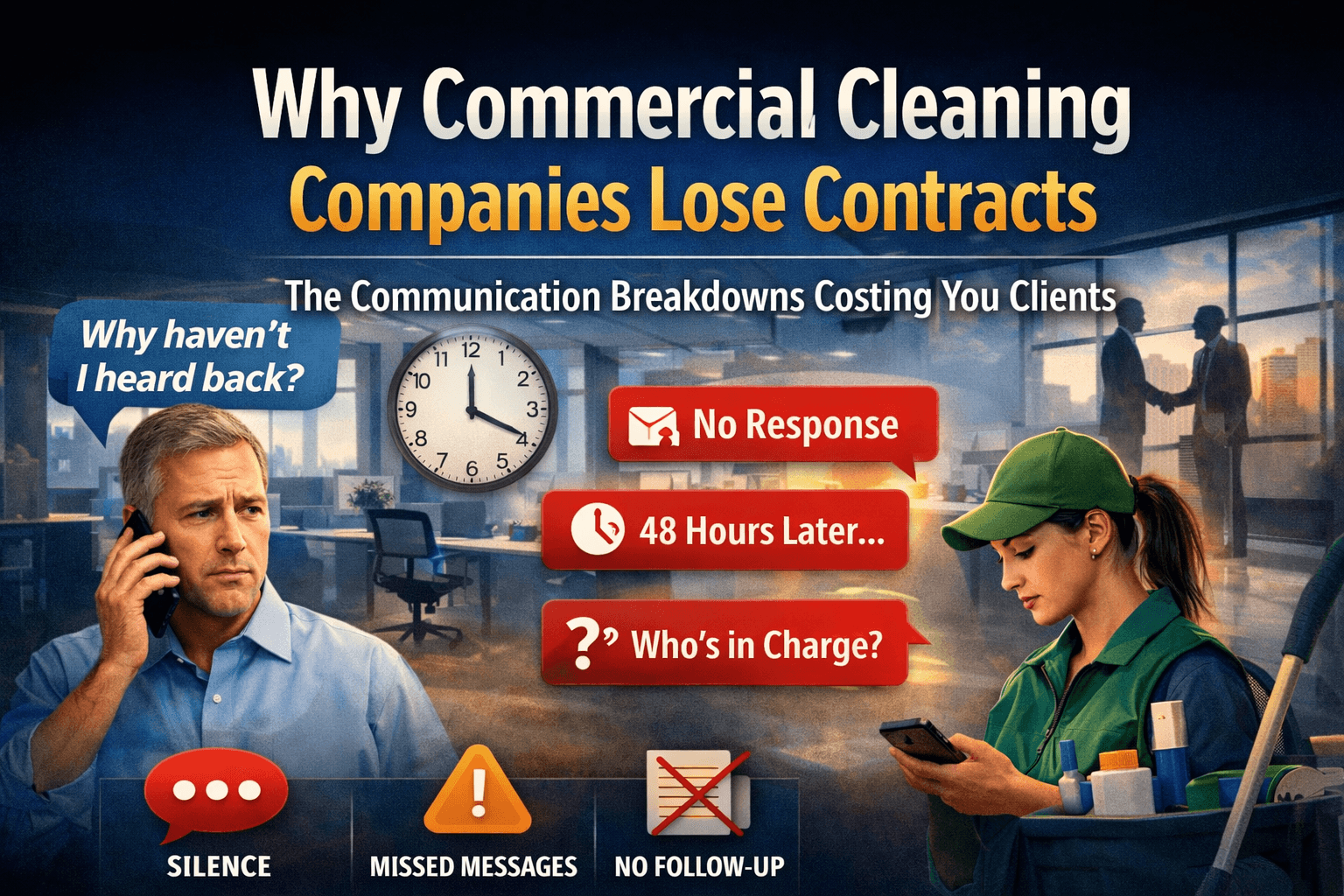
A commercial cleaning company does not lose contracts because the floors are dirty. The work is almost always satisfactory. The contracts get lost because the building manager spent six weeks trying to get a callback about a vendor change request and decided it was easier to switch cleaners than to chase the current one. That is the entire pattern of churn in the commercial cleaning industry, and it is structural.
This post lays out where communication actually breaks in a typical mid-sized cleaning operation, the 2026 industry data on contract churn, the three communication-failure patterns we audit for every cleaning client we onboard, and the 30-day shape of an AI-assisted communication build that closes the gap. By the end you should know which building manager in your portfolio is most likely to leave you this quarter and why.
Key takeaways
- Communication failures cause more contract churn in commercial cleaning than service quality failures. The data is consistent across industry sources.
- The three failure patterns: after-hours response gaps, lost service requests in shared inboxes, and the missing audit trail when issues escalate to property owners.
- AI in commercial cleaning works because it answers, logs, and routes communication 24/7. It does not replace your supervisors; it gives them a system of record.
- Bolt the AI layer onto your existing CRM or job management software (Aspire, Janitorial Manager, CleanTelligent). Migrating systems to get AI kills the project.
Why communication, not cleaning, drives churn
A building manager renewing a cleaning contract is asking one underlying question: when something goes wrong in this building, who do I call and how fast does it get fixed. The cleaning quality is table stakes. The communication response is the differentiator. Industry analysis of contract loss consistently puts communication failures at the top of churn drivers in commercial cleaning.
The asymmetry is brutal. A cleaning crew can do excellent work for 51 weeks of a year. In week 52, the building manager sends an email about a chair that wasn't moved and gets no acknowledgment for 72 hours. The decision to non-renew gets made not on the basis of the chair, but on the basis of "if this is how they communicate during a contract, what happens during a problem?" The chair was never the issue.
The math compounds. A typical mid-sized commercial cleaning operation loses 15-25% of contracts annually to churn. Even at the low end, that means a $5M-revenue company needs to replace $750K in contract value every year just to stay flat. Aspire's analysis of cleaning business challenges frames the same problem from the ops-software side.
What 2026 industry data actually shows
- Contract cleaning market growth: the global commercial cleaning services market continues to expand through 2026, but margin pressure is intense; operators that compete on price alone are getting squeezed. Market research on contractual cleaning outlines the macro picture.
- The AI shift: commercial cleaning is one of the industries where AI's role is rewriting how operations communicate, not displacing the labor itself. BSCAI's framing is that the industry is being "rewritten" by AI on the operations layer, not replaced by it on the labor layer.
- Customer service expectations: 2026 communication benchmarks across B2B service industries show response-time expectations have compressed dramatically. 2026 communication statistics document the trend.
- The ROI gap: industry analysis frames commercial cleaning's communication problems as a $225B problem when summed across the sector globally. The implication is that small operational fixes compound. Industry ROI analysis frames the scale.
- Failure mode consistency: independent analysis of why cleaning companies lose contracts puts communication at the center every time. Cleanscan's coverage of contract loss patterns is consistent with the Aspire and BSCAI data.
The pattern is clear and uncomfortable for an industry that has historically competed on price and labor quality. The lever in 2026 is the communication layer on top.
The three communication-failure patterns we see most often
Across the engagements we have shipped with mid-sized cleaning operators, three patterns repeat:
Pattern 1: the after-hours service request black hole. A building manager emails at 6 pm Wednesday about a spill that needs same-day attention. The cleaning company office is closed. The on-site supervisor's email inbox is full. By morning, the request has been forgotten. The building manager learns to escalate to property ownership next time, which is exactly the conversation that loses contracts.
Pattern 2: the shared-inbox accountability gap. Service requests come into info@ or service@. Three people in the office check it intermittently. Nobody owns the queue. Requests slip not from incompetence but from the standard failure mode of any inbox with no single owner. The building manager has no idea who to follow up with.
Pattern 3: the missing audit trail. When an issue escalates to the property owner, the cleaning company cannot produce a record of when the request came in, who handled it, what they did, and when. The cleaning company looks disorganized even when the actual work was correct. The contract gets reviewed at the next renewal and the renewal does not happen.
Each pattern is structural. Each is fixable without hiring. The leverage is putting an AI system in the communication path that handles first-touch, logs everything, and creates the audit trail automatically.
The buyer-side tell that signals churn risk is the email subject line. When a building manager starts subject lines with "Following up on..." or "Second request:" or copies the property owner on what should be a routine service note, the relationship is already four communication failures past safe. By the time the words "second request" appear, the contract is in soft churn even if the renewal is six months away. The operators who catch this signal early intervene through a supervisor visit; the operators who do not catch it learn about the non-renewal in a 30-day notice.
The vendor-side tell is just as predictable. A cleaning operator that cannot describe their first-response time in 2026 has a measurement problem, not just a response problem. You cannot fix what you cannot see. A two-week communication audit, even before any AI is deployed, surfaces enough leakage to justify the build on its own.
What an AI communication stack actually does for a cleaning operator
The right shape for a cleaning operator with 30-500 active contracts is narrow:
24/7 first-touch response. Inbound email, missed call, or text from a building manager triggers an AI agent that responds within 60 seconds, acknowledges the request, captures the structured details (building, urgency, issue type, contact preference), and either schedules the response or escalates to the on-call supervisor. Industry coverage of answering-service AI for cleaning describes the same pattern from the platform side.
Shared inbox triage. The AI reads every message in info@, classifies it by intent (service request, billing question, new lead, complaint), assigns ownership, and tracks resolution. The supervisor team works against a real queue with real SLAs instead of an inbox with no owner.
Audit trail automation. Every interaction (request, acknowledgment, dispatch, resolution) is logged automatically with timestamps and the responsible person. When a building manager or property owner escalates, the cleaning company produces a complete record in seconds.
Renewal-risk scoring. The AI watches communication patterns across each contract: response-time trends, request volume changes, complaint frequency, sentiment shifts. Accounts trending toward churn surface 60-90 days before the renewal conversation, while there is still time to intervene.
What the AI does not do: dispatch crews to job sites, train supervisors, replace the on-site quality work. Those are the activities that require human judgment and physical presence. Customer service automation engagements consistently split activities-vs-outcomes the same way: automate the procedural communication, route everything physical or judgmental.
The 30-day implementation path for a mid-sized cleaning operator
This is the shape we run at Hexa AI Agency when a cleaning operator asks us to ship AI workflow automation on the communication side.
Week 1: lock the baseline. Pull 90 days of inbound communication data from info@, the on-call phone log, and any existing job management software (Aspire, Janitorial Manager, CleanTelligent, Swept). Measure four numbers: total inbound by channel, current first-response time median, percentage of requests with an owner assigned within 1 hour, and 12-month churn rate by contract value. Document the attribution formula: if first-response time drops from 6 hours to 5 minutes and audit-trail completeness goes from 30% to 95%, what does that do to renewal probability based on the last 24 months of churn data?
Week 2: build the first-touch AI agent. Configure the AI for the operator's contract base, supervisor on-call rotation, and escalation rules. Integrate with the existing job management software via API. Pilot on inbound to info@ first; resist scope creep into dispatch or supervisor management.
Week 3: launch on a portion of inbound. Route after-hours and weekend traffic through the AI agent. Watch acknowledgment rate, time-to-dispatch, and building manager satisfaction (post-resolution micro-survey). Compare against the baseline.
Week 4: measure and decide. If first-response time dropped below 5 minutes, audit-trail completeness lifted above 90%, and building manager satisfaction held flat or improved, roll the AI to 24/7 coverage. If satisfaction dropped, the AI script needs tightening or the supervisor handoff is broken.
Budget realistically. The AI build for a 30-500 contract cleaning operator lands in the $8,000 to $20,000 range for the initial build, plus $400 to $1,000 per month for the AI usage on top of your existing job management subscription.
Frequently asked questions
How much does AI communication automation cost for a commercial cleaning company in 2026?
For a 30-500 contract operator, expect $8,000 to $20,000 for the initial build and integration with your existing job management software, plus $400 to $1,000 per month for the AI usage. A platform-only solution without custom integration work is cheaper but tends to lose value at the audit-trail layer.
Will AI replace my cleaning supervisors?
No. The AI handles the first-touch communication and the audit-trail work. The supervisor's role shifts toward higher-value tasks: building-manager relationship work, supervisor team coaching, and the renewal-risk accounts the AI flagged. Headcount stays flat or grows; output per supervisor roughly doubles.
What if my cleaning company is too small for AI communication?
Under 30 active contracts, the manual process can still work if one named owner has the responsibility. Above 30 contracts, the inbox-and-on-call pattern starts to leak and the leakage compounds. The cleanest signal that you need an AI layer: when a building manager escalates and you cannot find the original message in under 60 seconds.
When is AI communication the wrong answer for a cleaning operator?
When the team has not bought in (the AI will get bypassed), when the existing job management system is not API-accessible (rebuild that first), or when the leadership team has not yet documented today's churn rate. Without a baseline, the renewal-risk scoring has nothing to predict against and the build cannot prove ROI.
If you are evaluating an AI communication build for your cleaning operation and want a second opinion on the scope, book a call at cal.com/hexaiagency and we will read the proposal with you, free.