
8 min readUpdated
HVAC CRM for Maintenance Contract Retention (2026)
Why HVAC CRMs alone do not lift retention, the four-layer AI pattern that does, and the 30-day implementation that compresses one-time-customer churn.

Mike
Founder & AI Automation Lead
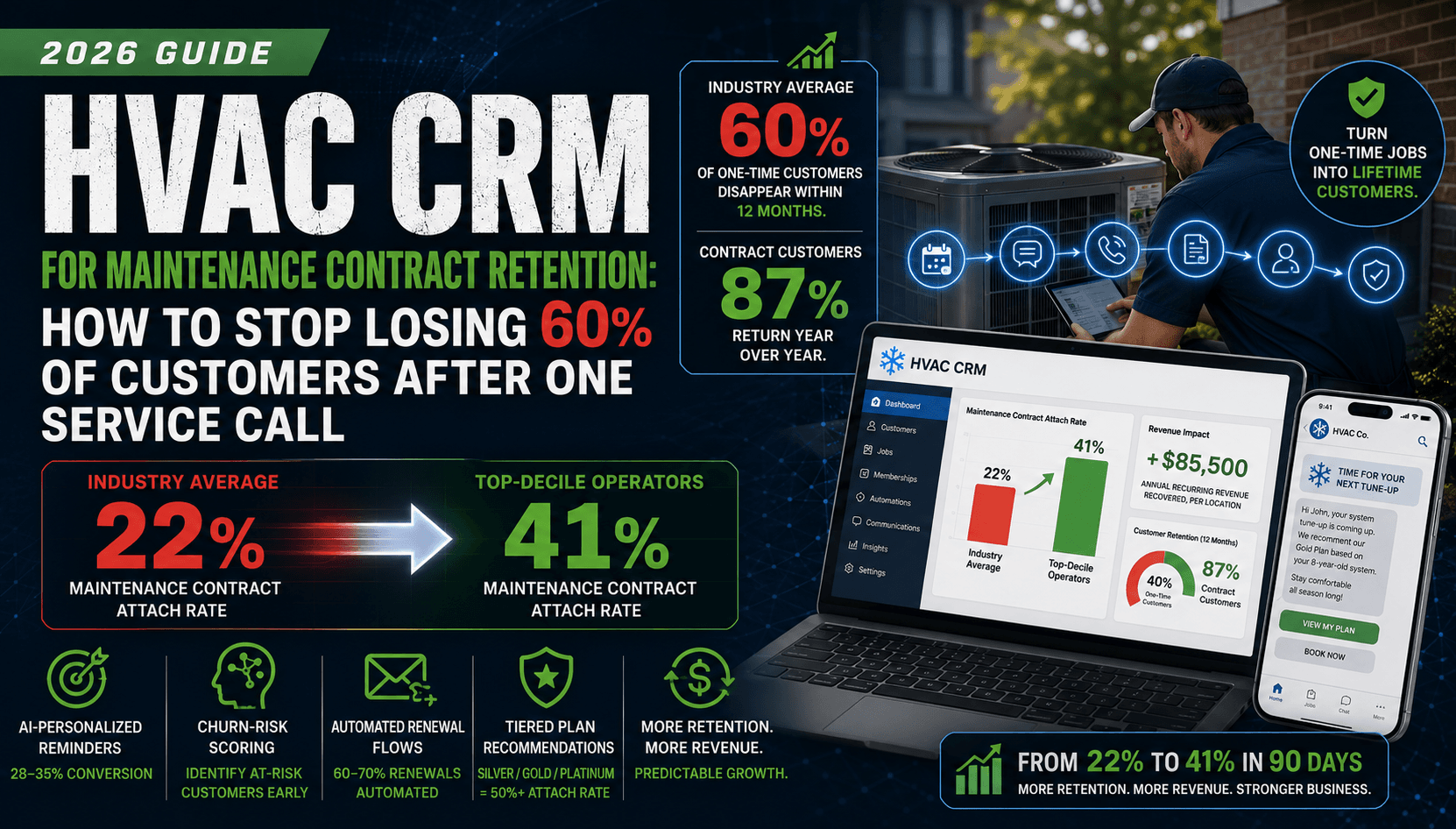
HVAC operators have known for decades that maintenance contract customers are worth materially more than one-time service customers. The lifetime-value math is not subtle: a maintenance contract customer typically renews year after year, accepts upsells more readily, and produces predictable recurring revenue that smooths cash flow across the seasonal cycle. The structural problem is that converting a one-time service call into a maintenance contract requires a coordinated sequence of touchpoints that most HVAC operators do not execute consistently. Industry retention math suggests 60% or more of one-time customers never come back to the same operator. The HVAC CRM is supposed to fix this; in practice it usually does not, because the CRM is the data layer and the operator has not built the workflow layer on top.
This post lays out why most HVAC CRM deployments fail to lift maintenance contract attach rates in 2026, the AI-assisted retention pattern that consistently does, the four scenarios where the AI should hand off to a human, and the 30-day implementation we run when scoping HVAC retention automation.
Key takeaways
- HVAC CRM platforms (ServiceTitan, Housecall Pro, FieldEdge, Jobber) are systems of record. They store the customer data; they do not run the retention workflow. The retention workflow is the AI layer on top.
- The pattern that works: offer the maintenance plan on every service call, automate the 6-month and 11-month follow-up sequences, score churn risk on customer behavior signals, and route the rate conversations to humans.
- Operators consistently see maintenance contract attach rates climb meaningfully when the AI retention layer is configured against documented baselines. Industry benchmarks for top operators sit in the 50-70% attach range; most operators sit in the 20-30% range.
- The buyer-side test for any HVAC CRM AI feature: does it move customer LTV measurably, or does it just produce more reports about LTV? Reports do not lift retention.
Why HVAC CRM deployments alone do not lift retention
An HVAC CRM is a database. It records the customer, the equipment, the service history, the billing relationship. The retention workflow that converts a one-time customer into a maintenance contract holder is not a database operation; it is a coordinated sequence of communication touchpoints that has to happen across months, against the operator's specific service plans and pricing, with the operator's tone. Most HVAC operators deploy the CRM, expect it to "improve retention," and discover that the database alone does not run the workflow.
The workflow has specific touchpoints. The maintenance plan offer at the end of every service call. The 6-month follow-up reminder (when the seasonal context is right for a tune-up). The 9-month touch (when the customer is statistically most likely to consider switching providers). The 11-month renewal conversation for existing plan holders. The 14-month reactivation outreach for lapsed customers. Each touchpoint requires both timing discipline and context-aware communication. Doing this manually across 1,000-3,000 active customers per residential HVAC operator is exactly the kind of work that quietly does not happen, because the CSRs and dispatchers are handling the day-to-day operational fires.
Parallel service-business analysis documents the same dynamic. The workflow layer is the lever; the system of record is the prerequisite.
The AI retention pattern that lifts maintenance contract attach rates
The pattern that works for residential HVAC operators with 500-3,000 active customers in 2026 has four functional layers.
Layer 1: maintenance plan offer on every service call. The AI generates a customer-specific plan offer based on the equipment age, the service history, and the seasonal context. The technician presents the offer at the close of the visit; if the customer says "maybe later," the AI captures the followup task and queues the next touch.
Layer 2: AI-driven follow-up sequence. 6-month, 9-month, and 11-month touchpoints handled by AI through the customer's preferred channel (typically SMS, sometimes email). Each touch carries the seasonal context (heating tune-up before winter, cooling tune-up before summer) and the operator's specific service plans.
Layer 3: churn risk scoring. The AI watches customer behavior signals (service history pattern changes, declining engagement, complaint frequency, pricing-question density) and surfaces accounts trending toward switching. The operator's customer success team intervenes before the customer has already moved providers.
Layer 4: rate-conversation routing. Any pushback on plan pricing or renewal terms routes to a human. The AI does not negotiate; the operator's CSR or dispatcher handles the conversation with full context attached.
Customer service automation engagements at HVAC operators use this four-layer pattern on top of the existing CRM, regardless of which CRM platform the operator runs.
What 2026 data shows on HVAC retention economics
- Industry analysis on response-gap and retention dynamics: service-business retention concentrates in operators who execute the post-service follow-up workflow consistently. Source.
- Salesforce on AI in customer service: AI's durable value sits at the procedural-coordination layer; HVAC retention follow-up fits cleanly. Source.
- McKinsey 2025 State of AI: value capture concentrates in operators who rewire workflows around AI; HVAC operators redesigning the retention motion around the four-layer AI pattern capture more value than ones bolting AI onto an unchanged process. Report PDF.
- Forrester on chatbot business case: AI deployments lacking documented baselines fail at renewal. HVAC retention automation must measure attach rate by month and customer lifetime value to survive review. Source.
- Gartner April 2026: AI projects across IT and operations stall ahead of meaningful ROI without baselines; HVAC AI fits the same pattern. Source.
- Kustomer on AI triage: triage discipline applies to retention too; rate negotiations and customer disputes go to humans. Source.
- RAND on AI deployment risk: misalignment between capability and business problem is the consistent root cause; AI deployed for procedural follow-up fits well, deployed for rate negotiation hits misalignment. Source.
- MIT NANDA 2025 analysis: 95% of corporate GenAI pilots produce zero measurable revenue. HVAC AI sits in the 5% that work when scoped to documented retention metrics. Source.
The four scenarios where the AI should hand off to a human
1. Rate or pricing pushback. The AI captures the conversation and routes to the operator's CSR or dispatcher. The human handles the rate adjustment, payment plan, or alternative plan offer.
2. Equipment failure mid-contract. A customer with a major equipment issue mid-plan needs operator judgment on warranty, replacement, and customer-retention investment. The AI flags; the operator's service manager responds.
3. Cancellation requests. A customer who wants to cancel a maintenance plan often negotiates if engaged thoughtfully. The AI captures the request and routes to a customer success conversation; the human decides whether to retain at the current rate, offer a discount, or accept the cancellation.
4. Customer complaints about service quality. Any complaint about a specific technician, visit, or repair quality needs human attention. The AI cannot evaluate service quality; the operations team can.
The 30-day implementation shape we run at Hexa
At Hexa AI Agency we run the same shape when an HVAC operator asks us to scope retention automation through AI workflow automation. Across the engagements we have shipped, the operators that lifted maintenance contract attach rates most consistently followed this order.
Week 1: lock the baseline. Pull 12 months of customer and service history from the CRM (ServiceTitan, Housecall Pro, FieldEdge, Jobber). Measure four numbers: current maintenance contract attach rate on new service calls, 12-month retention rate on existing contracts, average customer lifetime value, and current cost per acquisition. Document the attribution formula tied to recovered contract revenue.
Week 2: build the four-layer AI retention layer. Configure the AI for CRM integration, customer-specific plan generation, follow-up cadence rules, churn-risk scoring, and rate-conversation routing. Pilot on one service-area or one technician's customer book first.
Week 3: launch on the pilot scope. Run the four layers end to end. Watch attach rate, follow-up response rate, and customer satisfaction signals in parallel. Compare against baseline.
Week 4: measure and decide. If attach rate lifted at least 10 percentage points and customer satisfaction held flat or improved, roll the pattern across the operation. If satisfaction dropped, the AI tone or the offer cadence needs tightening before expansion.
Budget realistically. An HVAC retention AI build lands in the $8K-$20K range one-time, plus $400-$1,200 per month for the AI usage on top of your existing CRM subscription. Operators with portfolios above 1,000 active customers typically see net-positive ROI inside the first 90 days from recovered contracts alone. Our HubSpot CRM automation case study documents a related build pattern from an adjacent service-business context.
Frequently asked questions
What HVAC maintenance contract attach rate is achievable in 2026?
Top operators with disciplined retention workflows hit 50-70% attach rates on new service calls. Most operators sit at 20-30%. The gap is the difference between operators executing the four-layer retention motion and operators relying on the technician to remember to offer the plan and the front office to remember to follow up. AI absorbs the memory requirements.
How much does HVAC retention AI cost in 2026?
$8,000-$20,000 one-time for an integrated build with your existing CRM, plus $400-$1,200 per month for the AI usage. The cost is far smaller than the revenue impact of even a 10-percentage-point attach-rate lift on a portfolio above 1,000 active customers.
Will AI retention automation feel impersonal to HVAC customers?
Not if the AI matches the operator's tone and routes rate and dispute conversations to humans. Customers typically appreciate the seasonal-context reminders (tune-up before winter, refrigerant check before summer) when the tone is helpful rather than promotional.
When is HVAC retention AI the wrong investment?
When the operation is small (under 200 active customers), when the CRM does not expose customer-service history via API, or when the operator has not yet documented today's attach rate. Document the baseline first; deploy second.
If you are evaluating an HVAC retention AI build and want a second opinion on the scope, book a call at cal.com/hexaiagency and we will read the proposal with you, free. We do this often for operators combining retention with AI agent development on the inbound lead intake and dispatch sides, where the same CRM data layer powers all three workflows from a single integrated build.
One closing operational reality. HVAC operators who lift maintenance contract attach rates by 15-25 percentage points typically see their seasonal cash flow stabilize within two cooling-and-heating cycles. The recurring revenue from maintenance contracts buffers the seasonal demand swings that have historically forced operators to over-hire in shoulder seasons and lay off in slow weeks. The downstream effect on team retention, equipment investment timing, and supplier relationships compounds across the year in ways that the original retention ROI calculation rarely captures.
The closing strategic point. The HVAC industry has historically competed on service quality, response time, and pricing. The 2026 competitive landscape adds a fourth dimension: post-service retention discipline. Operators who execute the four-layer AI retention motion will capture share from operators who continue to compete on the first three dimensions alone. The maintenance contract attach rate is becoming the leading indicator of which operators will be acquired by consolidators at favorable multiples and which will be acquired at distress prices over the next 24-36 months of industry consolidation.