
10 min read
Proposal Sent, No Response: The 3/7/14 Follow-Up System
Why B2B proposals go quiet, and the fix: three fields on the document, a 3/7/14 day aging tracker, a four-touch cadence, and the CRM automation behind it.

Mike
Founder & AI Automation Lead
You spent four hours on the proposal. It went out on Tuesday with a friendly "let me know if you have any questions." It is now the following Thursday and nobody has said a word. You have six of these sitting with clients, the oldest three weeks old, and you feel weird about sending another "just checking in."
The instinct is to fix the email. That is the wrong layer. Firms that quote weekly do not lose these deals in the writing. They lose them in the gap between messages, because nobody in the building owns what happens after send. This post is the system for that gap: three fields on the document, one tracker, one cadence, and the automation that runs it.
Key takeaways
- Silence after a proposal is an ownership problem, not a wording problem. Give every sent proposal an owner, an expiry date, and a next-action date.
- Put a quote number, issue date, and validity period on every proposal, and send it as a PDF with a signed-acceptance step. It stops edited quotes and gives you a reason to follow up.
- Run a 3 / 7 / 14 day cadence: questions, next steps, then a close-out email with a date. Four touches, then move it to a quarterly nurture list.
- Wire the cadence into your CRM as stage-triggered tasks, and keep the actual conversation human.
- Stop sending proposals to people who refused a review call. It is the cheapest fix on this list.
Why do proposals go quiet after you send them?
Start with what buyers say when they go dark. In an r/sales thread on how many times to follow up on a proposal, the most useful answer listed four reasons: they picked another vendor, the project got delayed, something more urgent landed, or the price surprised them. Only one of those four has anything to do with your document, and in all four a better subject line changes nothing.
The industry data agrees. Loopio's 2026 survey of more than 1,500 response teams found that price remains the top stated loss reason, while only 13% of teams attribute losses to proposal quality. The same report puts the North American win rate at 37% and the effort at 33 hours per RFP. If six in ten proposals lose and each costs a working week, the silent ones are the most expensive documents your company produces.
One founder on r/Entrepreneur logged every minute spent on proposals for 30 days: 23 hours, including four proposals of two-plus hours each that never got a reply. One reply reframed the problem better than the founder had: the hook is not "write proposals faster," it is "get proposal accepted and paid faster." The proposal is not the deliverable. The decision is.
The clearest line came from a contractor who lost a bathroom renovation because he forgot to follow up: "A lot of people don't lose deals on price, they lose them in the silence between messages." Every fix below is aimed at that silence.
The three fields that make a proposal chaseable
A proposal you can follow up on has a handle on it. Most go out as a Word or Google Doc with a price at the bottom and no date, no number, and no end to the offer. So nothing gives you a reason to call, and the client can sit on it forever, or edit it.
That second problem is common. An r/smallbusiness thread on clients editing the quote after you send it drew 310 comments, and the top answer, with over 800 upvotes, was the whole fix in one sentence: send a PDF, require a signed acceptance, and print a quote number, an issue date, a validity period, and a note that only the latest version sent from your email address is valid. Add one field for your own side: an owner. A name, not a team.
The validity period is the most useful follow-up tool you own. Use 14 days for standard work, 30 for anything with subcontractor pricing, and print the actual date, not "two weeks." When the proposal says "pricing valid until 3 October," the day-7 email writes itself and the day-14 close-out is just the date. One salesperson in the six-proposals-waiting thread put it plainly: set an expiration date, then the follow-up can ask, for planning purposes, when they would like to move forward, with the date quoted as a fact.
Build the aging tracker before you buy any software
The renovation contractor above asked what small shops use to track sent quotes. The top reply was a spreadsheet with three columns, name, quote date, and follow-up date set three days out. Another added the rule that makes it work: "Never finish a quote without setting a reminder to follow up 3 days later. If it's not on the calendar, it doesn't exist."
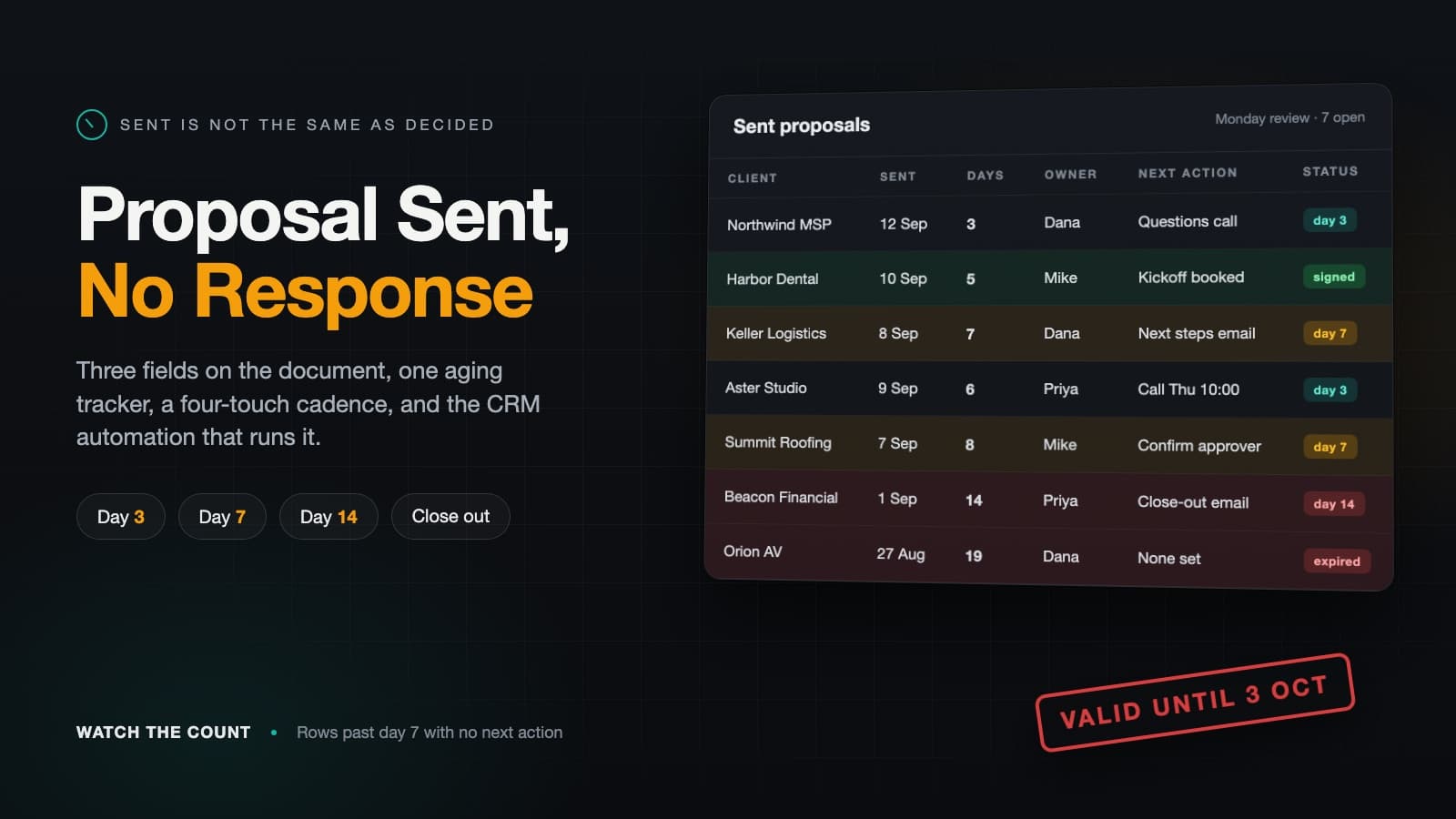
We agree, with one expansion. Here is the proposal tracking template we hand to clients before any automation gets built. It fits in Google Sheets or a Notion table.
- Client and quote number. One row per proposal, never per client.
- Value. So you can sort by what is at stake.
- Sent date. When the PDF left your outbox, not when you finished it.
- Expiry date. Copied from the document.
- Owner. The person whose calendar the follow-up lands on.
- Next action and next date. Blank is not allowed.
- Status. Sent, questions answered, verbal yes, signed, or closed-lost with a one-word reason.
Add a computed column, days since sent, and use conditional formatting in Sheets to colour rows at 3, 7, and 14 days. The number to watch each Monday is not pipeline value. It is the count of rows past day 7 with no next action. In our experience that count is the honest measure of revenue dying quietly, and it is usually higher than the sales lead expects.
Keep the tracker manual for the first month, so the automation later copies a real habit.
How many times should you follow up, and what do you say?
Four touches over two weeks, then stop. Sales veterans on Reddit argue for chasing "forever," and for a six-figure deal that is fair, but for a firm quoting weekly every stale row is a decision someone is not making. Here is the cadence we run.
Day 0: the send email sets the date
Do not end with "let me know if you have questions." End with a specific next step: "I'll call Thursday at 10 to walk through it, and pricing holds until the 3rd." The first follow-up is now booked in the email that delivered the proposal. If they push back on the call, that is information too.
Day 3: questions, not a check-in
Short. Ask if anything in scope or pricing raised a question. The most upvoted phrasing in the did-you-look-at-my-proposal thread was some version of "what are the next steps on your side?" followed by silence, letting them talk. Never "circling back."
Day 7: next steps and the expiry
Ask what the internal process looks like from here: who approves budget, who signs, and roughly when. Mention the validity date once, as a planning fact rather than pressure.
Day 14: the close-out
This is the email most firms never send, and the one that gets replies. Say that because the quoted pricing expires on the date shown, you will close the project in your system on a named day a week out, and that you would be glad to re-quote if timing shifts. When you suspect the project itself died, the one-liner works: "Have you given up on this? Happy to take it off my list either way." It is respectful, final, and easy to answer. After that, the row moves to closed-lost with a reason and a quarterly nurture touch.
Wiring it into Pipedrive or HubSpot so nobody has to remember
When we built the proposal generator for a digital marketing agency, described in our proposal automation case study, the build was all front half: a GoHighLevel webhook fires with the call transcript and budget fields, Make.com enriches the contact, GPT-4o-mini drafts the sections, and a Google Docs template is populated in minutes. Drafting time collapsed. What we saw next is the pattern behind this post: once drafting stops being the bottleneck, the leak moves downstream. Proposals go out faster and in larger numbers, so more of them sit in silence at any given time. Speeding up the write step without owning the follow-up step produces a bigger pile of unanswered documents.
So on every proposal automation build we now ship the back half too. The pattern is the same in Pipedrive, HubSpot, or GoHighLevel, and it needs no AI at all:
- A "Proposal sent" stage in the pipeline. Moving a deal into it is the trigger.
- Two required fields on the deal: expiry date and owner. The stage move fails without them.
- An automation that creates three tasks on the owner's calendar, day 3, 7, and 14, each with the message template attached. Pipedrive's native automations do this with a stage-change trigger and delayed actions; HubSpot workflows do the same.
- An alert three days before expiry if the deal is still in the stage.
- An automatic move to closed-lost seven days after expiry, reason field required, plus a Monday digest of everything past day 7 with no logged activity.
What we deliberately leave human is the conversation. The tasks land on a calendar and the templates are there, but a person makes the day-3 call. We push back on clients who want the whole sequence sent automatically: a follow-up from a robot reads as a robot, and the buyer knows it. The system's job is to make the follow-up impossible to forget, not to make it impersonal. That split, machine owns the timing and a human owns the contact, is the shape of most of our CRM automation work.
Stop sending proposals that were never going to close
Everything above assumes the proposal deserved to exist. A lot of them do not, and the silence started before you hit send. The most upvoted comment in a thread about a prospect who said "just send me the proposal, I'll get back to you" was blunt: someone who wants a written proposal without a meeting has usually already chosen another vendor and needs a comparison quote. Most of the 119 comments agreed.
The fix is a rule, not a skill. Before you write, ask for a 20-minute review call and a decision date. If the prospect refuses both, send a one-page ballpark and move on. The 135-upvote answer to "what is your favourite way to follow up on a proposal" was, in full: "Not sending it and reviewing it with them." Engineering firms apply the same discipline on cost: one r/civilengineering thread's rule of thumb is that a proposal should cost no more than 2-3% of the expected fee, which quietly kills most speculative bids before they start.
Loopio's data says the pressure runs the other way. Submissions are up to 166 per team per year, bandwidth is now the number one challenge for the first time, and use of a formal go/no-go process fell eight points to 75%. Teams are answering more and qualifying less, while the top performers winning over half their bids still qualify at 81%. Our earlier piece on how proposal automation shortens a B2B sales cycle covers the drafting side; this post is the half it left out.
Frequently asked questions
How many times should you follow up on a proposal before giving up?
Four touches over 14 days for a standard B2B quote: the send email with a booked call, a day-3 questions email, a day-7 next-steps email, and a day-14 close-out with a named date. Then mark it closed-lost with a reason and move it to a quarterly nurture list. Larger deals stretch the intervals, not the shape.
What should a proposal follow-up email say when the client has not responded?
Ask a question they can answer in one line: what the next steps are on their side, or whether anything in scope or price needs adjusting. Mention the validity date as a planning fact. Avoid "checking in" or "circling back," which ask for nothing. The final email states that you are closing the project on a named date unless they say otherwise.
How do I stop clients editing a quote after I send it?
Send a PDF, not an editable file, and require a signed acceptance before scheduling. Print a quote number, issue date, and validity period on every version, plus a line stating that only the latest version sent from your email is valid and changes need written approval. That closes the dispute before it starts.
If you quote weekly and cannot say, right now, how many proposals are past day 7 with no next action, that number is the place to start. Our free Operations Leak Audit walks your proposal stage from the fields on the document to the tasks in the CRM and hands you the stale count and the fix list before anything gets built. Bring your last 20 sent proposals.