
9 min readUpdated
Proposal Automation: Cut Days Off Your Sales Cycle
Proposal automation cuts response time 40 to 60 percent. Here is how it shortens a B2B sales cycle, the workflow to copy, and where it backfires.

Mike
Founder & AI Automation Lead
A B2B deal rarely dies in the demo. It dies in the gap between the demo and the signature, while a rep rebuilds a quote from scratch, waits three days for a manager to approve a discount, and emails a PDF that then sits unopened over a weekend. That gap is where a surprising amount of your sales cycle hides. Proposal automation goes straight at it: it pulls deal data from your CRM, assembles a tailored document in minutes, routes approvals by rule, and tells you the moment a buyer opens the pricing page. Here is how that compresses the cycle, and where it quietly fails.
Key takeaways
- The proposal-to-close stage is one of the most compressible parts of a B2B sales cycle, and automating it cuts proposal response time by 40 to 60 percent.
- Speed only helps if the document is accurate, so the real win comes from combining CRM-sourced data, a template library, and rule-based approvals, not just faster typing.
- Deals where the proposal lands within 24 hours close at higher rates, which is why turnaround time is the metric worth tracking.
- Automation backfires when it strips out the human judgment that complex or high-discount deals need. Govern it with approval rules instead of blanket speed.
Where a B2B deal actually stalls
Start with the honest number. The median B2B SaaS sales cycle now runs 84 days, with a mean closer to 134 days, and it stretches hard by deal size: sub-$15K deals close in a few weeks, while six-figure enterprise deals routinely take 90 to 180 days. Those cycles are also getting longer, not shorter. One 2026 analysis found B2B cycles have grown 22 percent since 2022, buying committees have expanded to an average of 6.3 stakeholders, and 86 percent of purchases stall at some point before signature.
The teams pulling ahead are the ones removing friction, not the ones adding salespeople. One 2026 dataset found AI-native sales programs cut their average cycle by 17 days year over year, while programs without that tooling lengthened by 9 days as buyer caution grew. That is a 26-day swing between teams doing the same job, and a lot of it comes down to how fast the late stages move.
Most teams respond by trying to speed up the top of the funnel, which is where the majority of the time lives. Fair enough. But the proposal stage is different: it is short, it is late, and it is almost entirely under your control. Nobody at the prospect's company is debating budget while your rep is copy-pasting last quarter's pricing into a Word file. The delay there is self-inflicted. When a proposal takes two days to build and another two to approve, you have added four days to a deal for reasons the buyer never sees and never forgives. That is the piece proposal automation is built to remove.
What proposal automation changes in the workflow
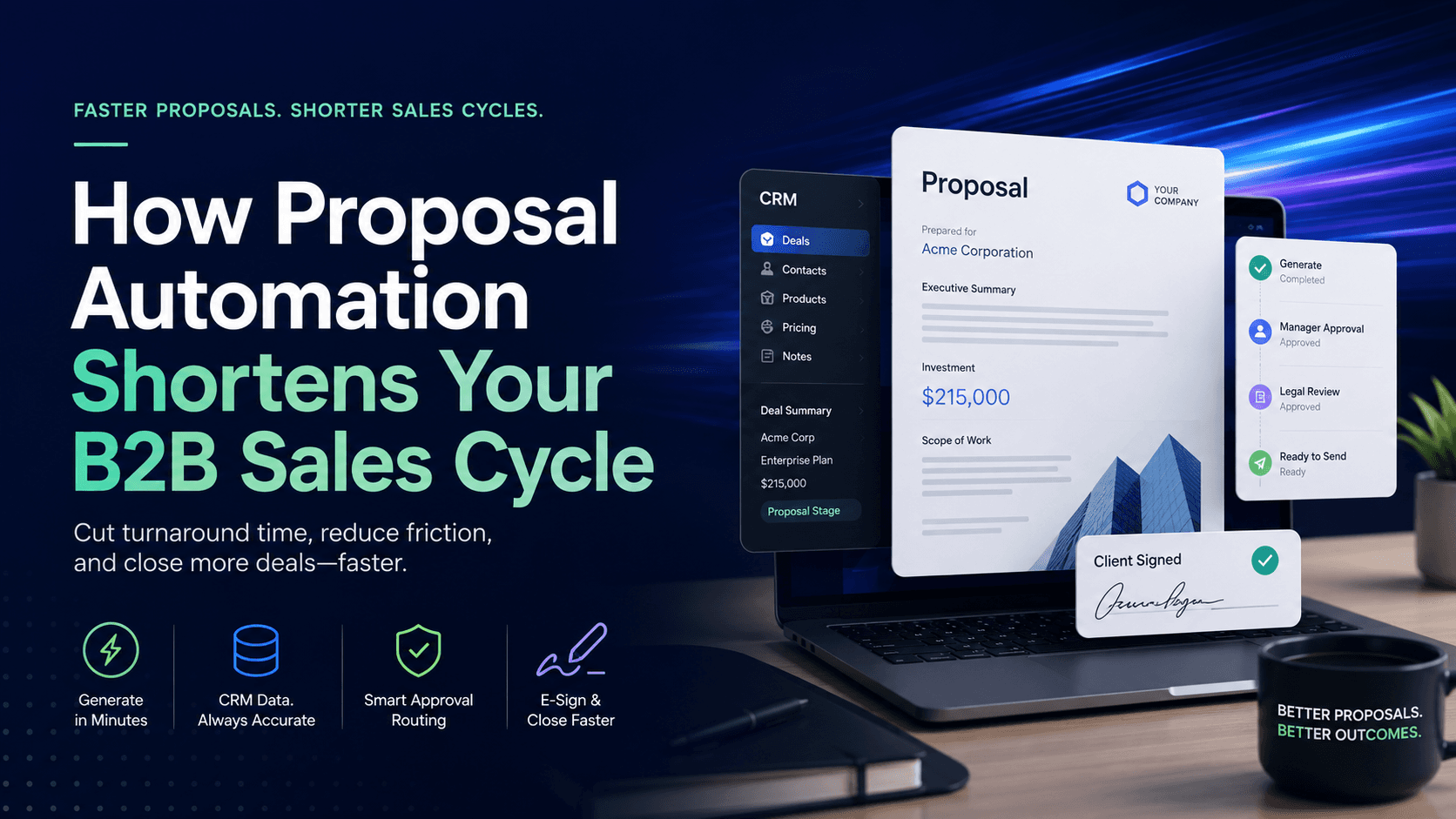
The mechanics are less exotic than the label suggests. When a rep clicks generate, the tool pulls pricing, terms, and contact details straight from the CRM and drops them into a ready template in seconds. The rep is no longer transcribing; they are reviewing. That single change is where most of the time saving comes from.
Four moving parts do the work:
- A template library keeps every proposal on-brand and legally consistent, so nobody ships an outdated liability clause. Tools like PandaDoc or HubSpot Quotes hold the master copy.
- A pricing engine applies your discount logic and product rules, which kills the back-and-forth over whether a bundle is even valid.
- Approval routing sends the document to the right person automatically when a deal crosses a threshold, instead of waiting for a rep to remember the policy.
- E-signature closes the loop inside the same flow. A large share of teams now bake signing directly into the proposal rather than exporting to a separate DocuSign step.
An AI drafting layer sits on top of that for the parts that used to be written by hand: the executive summary, the scope narrative, the tailored cover note. A model like Claude can draft those from the deal record and the call notes, then hand a first draft to the rep to sharpen. None of this works if the CRM underneath it is a mess, because the automation inherits whatever data quality you feed it. That is why we usually treat this as a data project first and a document project second. Getting the pipeline, contact records, and pricing catalog clean is the unglamorous prerequisite, and it is exactly the kind of work our CRM and AI integration engagements start with before any proposal automation gets switched on.
The turnaround-time math that shortens the cycle
Here is what the speed actually buys you. Proposal automation software cuts average proposal response time by 40 to 60 percent, and the ceiling is higher than that. One company cited in a McKinsey-referenced dataset took proposal turnaround from three weeks down to two hours and lifted revenue by 5 percent, which is why 78 percent of companies are increasing automation investment right now.
Speed changes the outcome, not just the effort. Analysis of buyer behavior shows that deals where the proposal lands within 24 hours close at meaningfully higher rates, and multi-threading a deal past three contacts can raise win rates by 130 percent on larger opportunities. Getting the document out same-day is not a nicety; it is a conversion lever. It also compounds. Shave two days off proposal turnaround on a pipeline of 40 open deals and you have handed your team roughly 80 selling days back a quarter, time that goes into follow-up instead of formatting.
The quality side holds up too. In one market study, 69 percent of B2B teams reported better conversion after adopting automated proposals, AI drafting cut manual content work by 46 percent, and 52 percent integrated e-signature to speed approvals. The pattern is consistent: you are not trading accuracy for speed, you are removing the manual steps that were slowing both.
What it looked like when we built one
Illustrative composite from recent engagements. A roughly 30-person commercial services contractor came to us with the classic version of this problem. Their reps lived in Pipedrive, but every proposal was a Google Doc rebuilt by hand, and a manager had to eyeball each one before it went out. Turnaround averaged about two working days, and roughly one in five proposals went out with a stale price because someone copied an old template.
We built the flow in Make, wired to Pipedrive as the source of truth. When a deal hit the "proposal" stage, the scenario assembled a document from a locked template, pulled the line items and pricing from the deal record, and applied one governance rule that mattered to them: any discount over 15 percent routed automatically to a manager for a one-click approval instead of a hallway conversation. Everything under that threshold went straight to the client with e-signature attached.
Two things stood out after launch. First, the stale-price problem effectively disappeared, because pricing now came from one place instead of a folder of old docs. Second, turnaround dropped from two days to same-day on the simple deals, which was most of them. The reporting side of that build looked a lot like our Pipedrive auto note-taker case study, and the document logic mirrors what we document in our proposal automation case study. The point is not the tooling. The point is that the two slow steps, drafting and approval, stopped being human bottlenecks and became rules.
When proposal automation makes things worse
This is where most write-ups go quiet, so let us be direct. Automation is the wrong first move for some teams, and shipping it anyway just makes a slow process fast and wrong.
Governance is the real gating factor. As one analysis put it, content approval rules, audit trails, and data-quality controls are what separate teams that scale from teams that stall. Skip that layer and you will generate polished proposals full of the wrong numbers faster than anyone can catch them. The second failure mode is over-templating. A highly bespoke, multi-year enterprise deal is not a mail-merge, and a prospect can feel a generic proposal from the first page. Automate the 80 percent of deals that are repeatable and leave a human in the loop for the rest.
The third is adoption. We have watched a clean build gather dust because reps quietly kept using their old Google Docs, usually because the new flow demanded CRM fields they never filled in. If the automation depends on data the team does not enter, it will not run, and no amount of tooling fixes that. Finally, volume matters. If your team sends fewer than a handful of proposals a month, the build cost outruns the payback, and a good template plus a signing tool is enough. Be honest about which bucket you are in before you spend a quarter on a workflow you will barely use.
One more we only learned by watching a build run in production: faster drafting moves the leak downstream. More proposals go out, so more of them sit unanswered at any given moment, and the generator gets blamed for a follow-up problem. If that is where your deals die, the fix is ownership of the gap after send, which we cover in what to do when a proposal is sent and gets no response.
Common questions before you automate proposals
How much of the sales cycle can this realistically remove?
Expect to compress the proposal stage itself, not the whole cycle. If proposals currently take two to four days to build and approve, automation can pull that to hours, and faster delivery lifts close rates on the deals you already have. It will not fix a slow discovery process or an indecisive buying committee.
Do we need a dedicated proposal tool, or can our CRM do it?
For simple quotes, a CRM plus an e-signature add-on often covers it. Once you need template libraries, discount rules, and approval routing across a team, a purpose-built layer wired to the CRM pays off. The deciding factor is complexity and volume, not company size.
What breaks first when teams roll this out?
Data quality. The automation copies whatever is in the CRM, so wrong pricing, duplicate contacts, and stale line items show up faster and more visibly than before. Clean the underlying records first, then automate on top of them.
How long does a build like this take?
A focused proposal flow on a healthy CRM is usually a two-to-four-week build: a week to map the process and clean data, a week to wire the template and rules, and a short pilot with a few reps before you turn it on for everyone. Messy CRM data is what stretches that timeline, not the automation itself, so it pays to audit your records before the first build session.
If your deals keep stalling in the days between "send me a proposal" and a signature, that gap is measurable and it is fixable. Map how long your proposal stage takes today, then book a working session with us at cal.com/hexaiagency to design the smallest automation that removes it.