
9 min read
How to Stop Employees Pasting Company Data Into ChatGPT
Your team is already pasting client data into free AI tools. Here is the walled garden fix that works, plus the one page policy to make it stick.

Mike
Founder & AI Automation Lead
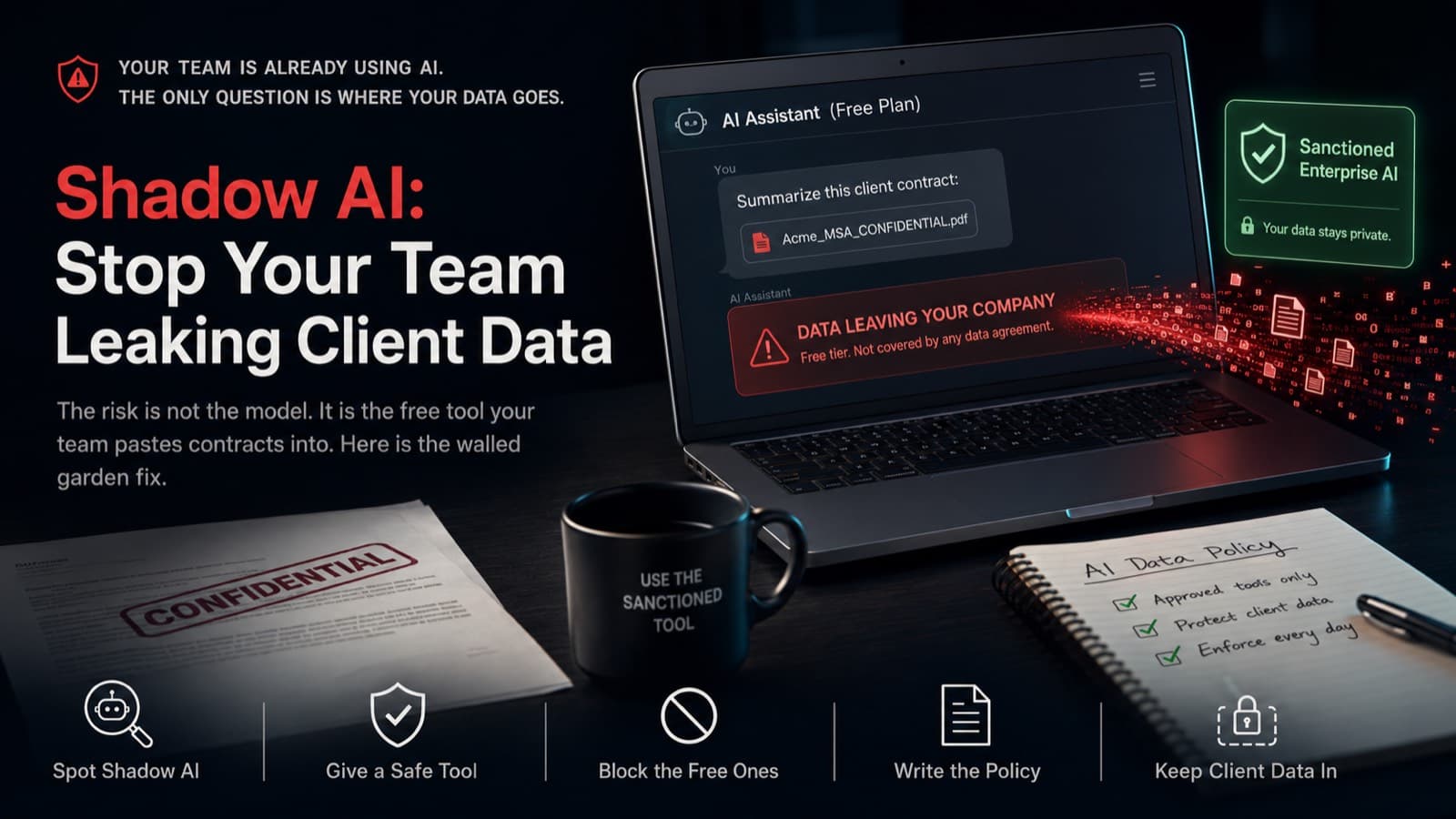
Someone on your team has a client contract open and a deadline in two hours. They do not want to read forty pages. They search for a free PDF summarizer, upload the contract, and get a clean summary in about nine seconds. No policy was broken, because there is no policy. No alert fired, because nothing was installed. That file now sits on a server owned by a company nobody at your firm has ever evaluated.
That is the real shape of an AI data leak at a 10 to 200 person business. Not a hacker, not a model that memorized your secrets. Just a capable employee with a deadline and no safe option in front of them.
We build sanctioned internal AI setups for professional services firms, and this pattern turns up in almost every environment we walk into.
Key takeaways
- The risk is not that a model trains on your data. It is shadow AI: staff pasting contracts, client records, and source code into free tools nobody vetted.
- Cyberhaven measured 11 percent of what employees paste into AI tools as confidential. A 2026 BlackFog survey put unsanctioned use at 49 percent of workers, and senior leaders are the worst offenders.
- A ban does not work. It moves identical behavior onto personal phones, where you have no visibility and no logs at all.
- The fix is a walled garden: one sanctioned enterprise tool that contractually does not train on your data, free tools blocked and redirected, and a one page policy with a named owner.
- An enterprise LLM under a data processing agreement carries the same trust posture as Gmail or Microsoft 365. The line that matters is free consumer tier versus enterprise tier, not AI versus no AI.
The leak looks nothing like the headline version
The 2023 panic was about training. The fear was that you paste a merger memo into a chatbot, the model swallows it, and a competitor later prompts it back out. That story drove the early bans. Axios reported in March 2023 that JPMorgan Chase and Verizon had blocked employee access outright while Walmart and Amazon warned staff not to paste anything confidential. Samsung went further after engineers pasted proprietary semiconductor source code and internal meeting notes into ChatGPT three separate times inside twenty days, and banned generative AI on company devices.
Three years on, the exposure is worse and the cause is duller. Cyberhaven, analyzing activity across 1.6 million knowledge workers, found that 11 percent of everything employees paste into AI tools is confidential: source code, client records, financial data, legal documents (figures verified 2026-08-12). That is not a rogue actor number. That is a Tuesday.
And it has not slowed down. A BlackFog survey of 2,000 workers at companies with more than 500 employees, published in January 2026, found 49 percent adopting AI tools without employer approval. The uncomfortable detail in that data is who leads the charge. Approval of unsanctioned AI use ran to 69 percent among C-suite and presidents, higher than among the staff those executives are supposed to be governing.
So the honest diagnosis is not that AI is dangerous. It is that your team is already using it, mostly on free consumer tiers, and you have no record of what went where.
Why a ban does not work
Blocking AI domains at the firewall feels decisive and buys almost nothing. The employee with the contract and the deadline pulls out a personal phone, or forwards the document to a personal email address and works from a laptop at home. The work still gets done, the data still leaves, and now it leaves through a channel you cannot see, cannot log, and cannot audit after the fact.
The version we hear most often from IT leads: the answer is always "we are developing a policy," and when you ask how it is enforced, the answer is nothing.
A ban with no sanctioned alternative trades a manageable risk for an invisible one. You have not removed the behavior. You have removed your own visibility into it, and you have taught a competent employee that following the rules means doing their job badly.
There is a second failure mode worth naming. Some firms write the policy, circulate it once, and treat the PDF as the control. Nobody owns it, nothing checks it, and no tool exists to make the compliant path convenient. That is theater, and everyone in the building knows it within a month.
Build the walled garden first
The order of operations matters more than any single control. Give people a safe tool before you take the unsafe ones away. Pick one sanctioned option and standardize on it: Microsoft 365 Copilot if you are already a Microsoft shop, ChatGPT Business or Enterprise, or Claude Team or Enterprise.
What you are buying is a contract, not a smarter model. OpenAI states that it does not train on business data from ChatGPT Business, Enterprise, or the API platform, and offers a data processing addendum plus a business associate agreement where HIPAA applies. Anthropic's commercial terms cover Claude Team and Enterprise the same way, with a DPA standard on business accounts. Microsoft says prompts, responses, and Microsoft Graph data in Microsoft 365 Copilot are not used to train its foundation models and stay inside your compliance boundary.
Read the consumer terms beside those and the gap is obvious. Anthropic's consumer terms now use an opt-out model for training on chats, which means the default on a free personal account is not the default on a business one. Same brand, same interface, completely different contract. That is the line your policy needs to draw.
Across our engagements the deciding factor has never been model quality. It is whether the sanctioned tool shows up behind single sign-on, on the desktop, on day one of onboarding, inside the applications people already have open. If the approved tool takes three clicks and a password reset while the free one takes zero, the free one wins every time. Standing up a properly scoped internal assistant is straightforward AI agent development work, and it is the control that does most of the actual risk reduction.
Block and redirect what is left
Once the safe path exists, close the others. Web filtering handles the long tail of free summarizers and random chatbot sites. For the data itself, endpoint DLP is the sharper instrument: Microsoft Purview can warn or block when someone pastes sensitive content into a browser, so a user attempting to drop client records or card numbers into a chatbot gets stopped at the moment it happens rather than in a report next quarter. Purview also extends this to unsanctioned AI apps across Edge, Chrome, and Firefox.
Two implementation details decide whether this holds. First, redirect rather than dead-end. A block page that says "access denied" produces a workaround; a block page that says "use Copilot instead, here is the link" produces compliance. Second, run in warn or audit mode for the first two weeks before you enforce anything. You will discover which teams depend on which tools, and you will avoid breaking a workflow that turns out to be load-bearing.
Audit mode also surfaces the gap between what your systems report and what is actually happening, which is the same class of problem we wrote about in silent automation failures. A green dashboard is not evidence that the control works.
The one page AI policy, and what belongs in it
Keep it to a single page. Anything longer does not get read, and an unread policy is not a control. Five parts cover it:
- Approved tools. Name them explicitly, with the account type. "Microsoft 365 Copilot via your work account" is a rule. "Approved AI tools" is not.
- Prohibited data. Spell out what never goes into any AI tool regardless of tier: client identifiers, PHI, credentials, unreleased financials, privileged material.
- Data classification. Three tiers is plenty. Public, internal, confidential. People need a fast test they can apply without asking anyone.
- Human review. No AI output reaches a client, a filing, or a system of record without a named person checking it. State who reviews what.
- Training and ownership. One person owns this document, it is reviewed quarterly, and every new hire covers it in week one.
Regulated work needs one addition. If you handle PHI, the business associate agreement is the gate, not the vendor's marketing page, and that shapes which tier you can buy at all. Firms in healthcare operations should settle that question before a single account is provisioned. Law firms carry a further duty: ABA Formal Opinion 512, issued 29 July 2024, requires lawyers to understand how a generative AI tool handles their data, and to obtain a client's informed consent before entering information relating to a representation into a self-learning tool.
Frequently asked questions
Is ChatGPT safe for confidential information?
On a free consumer account, treat it as unsafe for anything you would not email to a stranger. On ChatGPT Business, Enterprise, or the API, OpenAI contractually does not train on your inputs or outputs and will sign a data processing addendum. The product name is identical; the confidentiality posture is not. Buy the business tier before anyone touches client material.
Does ChatGPT Enterprise train on your data?
No. OpenAI's enterprise privacy commitments state that business data from ChatGPT Business, Enterprise, Edu, and the API platform is not used to train or improve its models by default. Those tiers also carry third-party security auditing and support GDPR, CCPA, and HIPAA compliance. This is the single clearest reason to move your team off free accounts.
Is it safe to use ChatGPT with client data?
With an enterprise agreement in place, the confidentiality question becomes the same one you already answered for Microsoft 365, Gmail, or your practice management system: a vetted third party processing client data under contract. Check your own client agreements and any confidentiality clauses first, since some name approved subprocessors and require notice.
Is ChatGPT confidential for lawyers?
Not on a consumer tier. ABA Formal Opinion 512 requires you to know how the tool uses inputs and to put safeguards in place against unauthorized disclosure. For self-learning tools, client informed consent is required before entering matter information. An enterprise tier with a signed DPA and no training on inputs is the workable path most firms land on.
What should an AI acceptable use policy for a small business cover?
Five things: the named approved tools, the categories of data prohibited everywhere, a simple three tier classification scheme, a human review requirement before AI output reaches anyone external, and a named owner with a quarterly review date. One page. Written in plain language, not legal language, because the audience is your whole staff.
Shadow AI is not a security problem that arrived from outside. It is an operations gap: work moved faster than the tooling you gave people, so they sourced their own. The fix is the same as any other operations gap, which is to make the correct path the convenient one and then measure whether people are actually on it. If you want to know what your current exposure looks like before you spend anything, Hexa AI Agency will map it: which AI tools your team is already using, what categories of data are moving through them, and what a sanctioned setup would cost against the risk it removes. Start with a free Operations Leak Audit, or read how we approach AI workflow automation if you would rather see the method first.