
10 min readUpdated
Why AI Projects Fail in 2026: The Honest ROI Truth ---
Most AI projects in 2026 stall before they show ROI. Here's the real reason, the 2026 data nobody puts on a deck, and the 7-question buyer diagnostic. ---

Mike
Founder & AI Automation Lead
Most enterprise AI projects in 2026 stall before they produce a single dollar of measurable ROI. That is Gartner's own framing in their April 2026 press release on AI in infrastructure and operations. It sits alongside the MIT NANDA project's 2025 finding that 95% of generative AI pilots produce zero measurable revenue impact, and McKinsey's 2025 State of AI report showing real value capture concentrated in a small minority of organizations.
If you have bought a chatbot, a copilot, or an automation in the last 18 months and you cannot point to a single number that moved, you are not the exception. You are the rule. The reason why AI projects fail in 2026 is rarely about the model, the prompt, or the integration.
This post lays out the real reasons AI projects fail, the 2026 AI project failure rate data nobody puts on a sales deck, the 7 questions every business owner should ask before signing with an AI agency, and a 30-day pilot blueprint you can run before you spend a dollar on the next vendor.
Key takeaways
- The dominant reason AI projects fail is not technical. It is that the buyer never set a baseline metric, so the AI's impact cannot be attributed back to the P&L.
- 2026 reporting is brutal. Gartner expects 60% of AI projects without AI-ready data to be abandoned through 2026, MIT NANDA puts the generative AI pilot failure rate at 95%, and RAND's research shows AI projects fail at twice the rate of non-AI IT projects.
- Chatbots and AI tools without an attribution model become impossible to defend at renewal. The buyer renews on vibes, then cancels.
- Run a 30-day diagnostic-first pilot with a documented baseline before any full build. The right AI partner will refuse to skip it.
The AI agency crash is coming, and it mirrors 2020 marketing agencies
The pattern looks familiar to anyone who watched the marketing-agency wave five years ago. Every kid with a laptop started a marketing agency. Run ads, manage content, charge a retainer. The math was obvious: pay $2,500 a month plus ad spend, get $15,000 in revenue back. The business owner could attribute every dollar. Renewal was automatic.
Now every kid with a laptop is starting an AI agency. Selling chatbots, automations, "AI transformation," charging $5,000 setups and $3,000 monthly retainers.
When a business owner pays $5,000 for a chatbot, how do they measure the return? They cannot. There is no number to point to. No revenue increase to attribute. No hours saved that show up in a P&L line item. So they do not renew. They do not refer. They lose interest. And in 12 months that AI agency is dead.
The AI agencies that survive 2026 will be the ones that diagnose first, then build. They walk into the business, find the actual problem costing money, then sell AI as the fix for that specific problem. Now the value is obvious. Now the customer renews. Now they refer.
The buyer-side tell is the same every time. The contract names a feature, not a metric. "AI-powered customer support" is a feature. "Reduce first-response time from 4 hours to 30 minutes, attributable in the CRM" is a metric. The first one closes. The second one renews.
The real reason AI projects fail: nobody measures the ROI
Walk into any failed AI project post-mortem and you will hear the same story. The vendor demoed well. The team got excited. The chatbot got deployed. People used it for a while. Then someone in finance asked, "what did this actually do for us?" Silence.
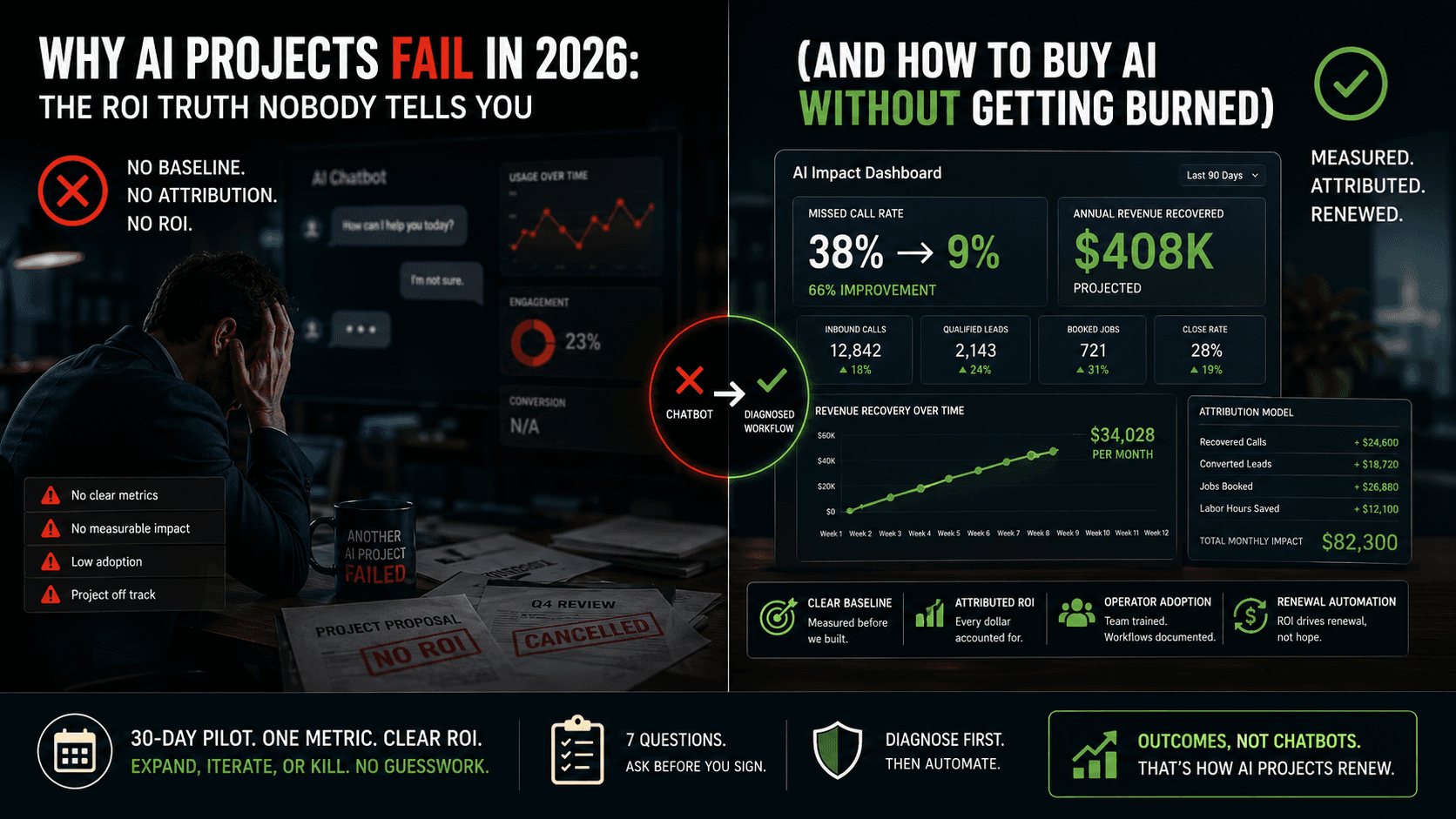
The single biggest reason AI projects fail is not technical. It is that the buyer never defined the baseline before the build started. If you cannot state today's number for the metric the AI is supposed to move, you have no way to prove it moved. You cannot say a missed call rate dropped if you never measured the original rate. You cannot say you saved hours of CSR time if you never tracked CSR time to begin with.
RAND's research on AI deployment risk consistently points at the same root cause: misalignment between the AI capability and the business problem. That is a polite way of saying nobody asked what problem we were solving until after the invoice cleared.
Real ROI measurement needs three things, and most AI agencies will let you skip all three:
- A baseline metric pulled before deployment. Call answer rate, lead-to-close ratio, hours per task. Documented in writing.
- A control group or pre/post comparison window. Either a held-out portion of customers, or a clean 60-90 day window before and after.
- An attribution model. Revenue recovered, hours saved times loaded labor rate, contract renewal rate change. A formula that converts the AI's output into dollars.
If your AI vendor cannot describe all three on the first call, you are buying a chatbot that will not survive renewal.
AI project failure rate: what the 2026 data actually shows
If you are going to argue this at scale, you need receipts. Bring these to your next board meeting or vendor conversation. The numbers do most of the talking:
- Gartner (April 2026): AI projects in infrastructure and operations are stalling ahead of meaningful ROI, and Gartner has also predicted that 60% of AI projects without AI-ready data will be abandoned through 2026. Source.
- MIT NANDA 2025: 95% of corporate generative AI pilots produce zero measurable revenue impact. The framing put the failure squarely on procurement and integration, not the models. Analysis.
- McKinsey 2025 State of AI: Real value capture from AI remains concentrated in a small share of organizations, and the ones moving the P&L are the ones rewiring workflows, not the ones bolting AI onto existing tools. Report PDF.
- BCG 2024: Only a fraction of companies translate generative AI investment into bottom-line impact. The differentiator is operating-model change, not tooling. Source.
- RAND: AI projects fail at roughly twice the rate of non-AI IT projects, with the most common root cause being misalignment between the AI capability and the business problem. Source.
- Forrester on chatbot ROI: enterprise chatbots that fail at renewal almost always lack a documented business case that ties the bot's output to a P&L line. The model is rarely what's wrong. Source.
The shared thread across all six is the same. The technology works. The contracts around the technology do not, because no one wrote down what success was supposed to look like before the build started.
Why chatbots without diagnosis do not survive renewal
The vendor pitches a chatbot. The buyer says yes because chatbots feel like AI. Six weeks later it is live. Three months later usage is decent. Twelve months later the renewal email lands and nobody on the buyer's side can defend the spend.
The chatbot was never tied to a P&L outcome. It was tied to a feature. "Answer FAQs," "deflect tickets," "qualify leads." Those are activities, not outcomes. Activities make demos look good and renewals look optional. Outcomes survive scrutiny.
The vendor pattern is recognizable too. The proposal lists capabilities (intent classification, sentiment routing, knowledge-base retrieval) without naming a P&L line the buyer will check at month 12. Capabilities are the demo. P&L lines are the renewal.
Illustrative composite from recent engagements. Compare two builds at identical price points. Build A is an on-site chatbot we shipped with the baseline metric set before launch, an attribution model that logged every closed deal against its source via a session ID handed off to the CRM, and a renewal trigger tied to the resulting dollar figure. Build B is the same chatbot from a competitor, sold flat retainer, no baseline, no attribution. A renewed at year one. B did not. The difference was not the prompt. It was that A's owner could put a dollar figure on the bot's contribution and B's could not.
The diagnosis-first framework: how Hexa AI Agency builds AI that renews
Hexa AI Agency rebuilds AI implementations regularly for small and mid-market businesses after their previous vendor delivered a chatbot or automation that nobody could measure. The pattern that works is boring on purpose. The defensible numbers belong to the case studies, not to a deck.
Across the engagements we have shipped, the shape is identical: a documented baseline metric before code is written, an attribution formula that converts the AI's output into dollars, and a renewal trigger tied to that formula. Forrester's work on the chatbot business case (cited above) argues the same thing from the buyer side. The math is not new; the number of AI agencies still selling renewals without it is.
The standard shape is three phases. Phase one is a two-week operations audit with the owner and the frontline team, pulling CRM, scheduling, and phone-log data to identify the workflow where AI can attribute recovered revenue or saved cost. Phase two is the smallest scope that proves or kills the thesis in 30 days, with the baseline and attribution model documented before code is written. Phase three is the rollout, only after the pilot moves the metric in the documented direction. Our AI agent development engagements are scoped this way by default; we will refuse the build if the buyer asks us to skip phase one.
7 questions to ask before hiring an AI agency
Before you sign with any AI vendor in 2026, walk them through this list. The right vendor will welcome every one of these. The wrong vendor will deflect.
- What specific business metric will this AI move, and what is the baseline number today?
- How will we attribute revenue, recovered cost, or saved hours back to the AI system?
- What is the smallest scope we can pilot in 30 days that proves or kills the thesis?
- What does failure look like, and at what point do we pull the plug?
- Who on our team owns this internally, and how do they get trained?
- What is the renewal trigger? A specific ROI threshold, or a vibe check?
- Have you operated in our industry before, and can we talk to two of your existing clients in the same vertical?
If the vendor cannot answer question one on the first call, you do not have a partner. You have a contractor. Hire accordingly, or do not hire at all.
How to avoid AI project failure: the 30-day pilot blueprint
Run this before the full engagement. The pilot is not a demo; it is a falsifiable test.
- Week 1: lock the baseline. Pull the metric from the CRM, scheduling tool, or phone logs. Document the attribution formula in a shared sheet. Both sides sign off.
- Week 2: build the AI workflow on one team, one queue, one customer segment. Resist scope creep.
- Week 3: run it live with a control group or a pre/post comparison window. No tweaks during the measurement period.
- Week 4: measure against the baseline. Decide: expand, iterate, or kill.
Budget realistically. A real diagnostic-first pilot lands in the $8,000 to $25,000 range. A chatbot demo that will not survive renewal runs zero on the invoice; the cost shows up later as a dead retainer. The pilot's job is to fail fast or expand fast. Either outcome saves money. If you want this scoped against a specific workflow in your business, we run this on AI workflow automation engagements all the time. The Anthropic Claude docs are a good starting place if you want to do it yourself.
Frequently asked questions
What is the AI project failure rate in 2026?
The most-cited 2026 figures come from MIT NANDA (95% of generative AI pilots produce zero measurable revenue impact) and Gartner (60% of AI projects without AI-ready data expected to be abandoned through 2026). The variance reflects scope. Both numbers point at the same root cause, which is missing baselines and attribution rather than the underlying models.
How do I measure ROI on an AI chatbot?
You need three things: a baseline metric pulled before deployment, a control group or pre/post comparison window, and an attribution formula that converts the bot's output to dollars. If you cannot set up all three, the bot will fail at renewal regardless of how well it performs day-to-day.
How much should a 30-day AI pilot cost?
For a real diagnostic-first pilot scoped against one workflow, expect $8,000 to $25,000 all-in. A vendor offering a "free pilot" is almost always selling a demo. The pilot must include the baseline, the attribution model, and a falsifiable success threshold, otherwise it is not a pilot.
When is AI the wrong tool?
When the workflow is not measurable, when the team is not bought in, or when the upstream process is broken. AI accelerates whatever is in front of it, including bad processes. Fix the process first, then layer AI. If a vendor will not say "this is not the right job for AI" out loud, find a different vendor.
If you are evaluating an AI vendor and want a second opinion on the pilot scope, book a call at cal.com/hexaiagency and we will read the proposal with you, free. We do this often for teams evaluating customer service automation and adjacent workflows.