
11 min readUpdated
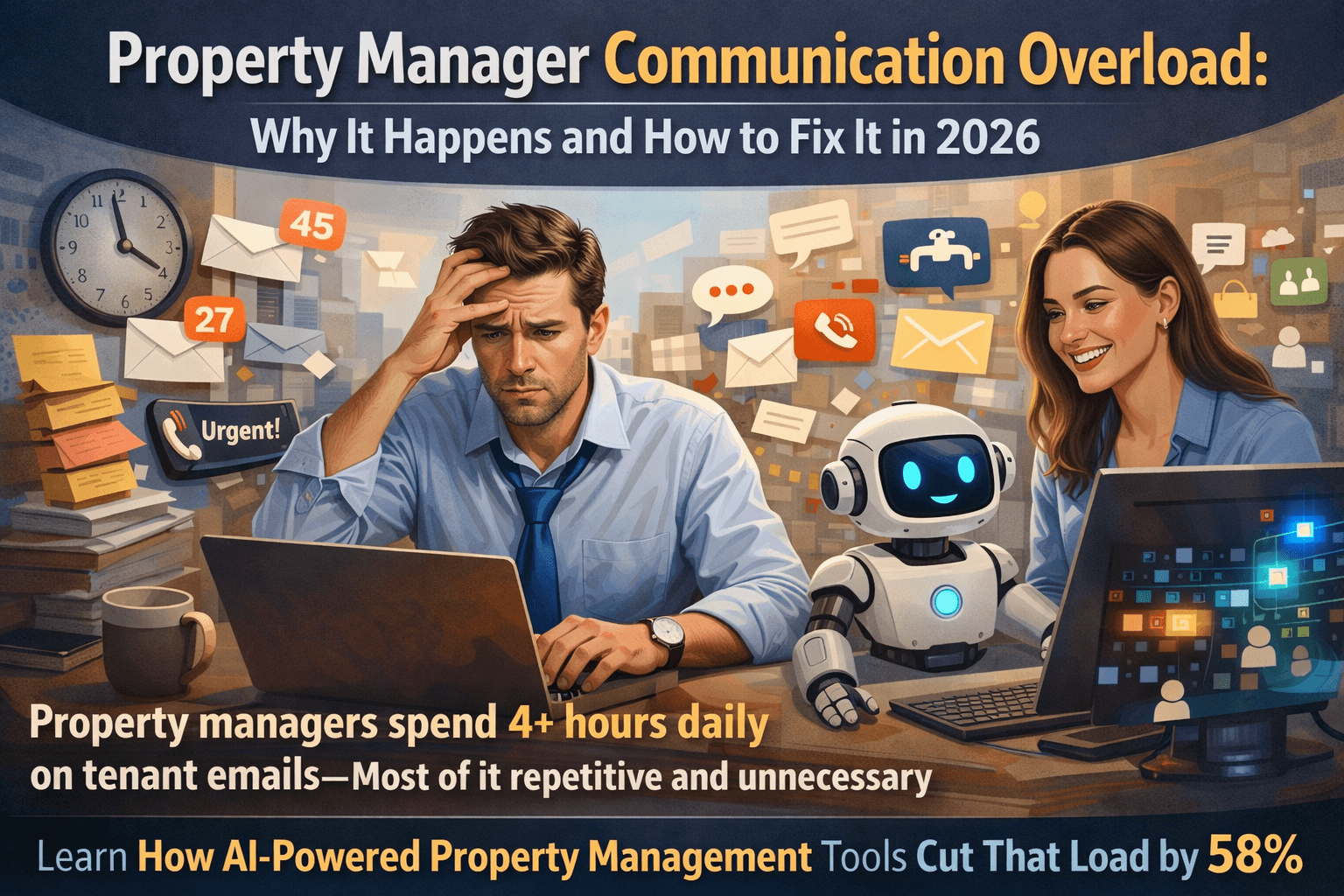
Property Manager Communication Overload: Why It Happens and How to Fix It in 2026
Property managers spend 4+ hours daily on tenant emails most of it repetitive and unnecessary. Learn how AI-powered property management communication tools cut that load by 58%.

Mike
Founder & AI Automation Lead
What Is Property Manager Communication Overload?
Property manager communication overload is what happens when tenant message volume exceeds what a manager can reasonably handle without sacrificing response quality, speed, or their own wellbeing.
The average property manager spends 3 to 4 hours per day reading and responding to tenant messages. Not resolving issues. Not growing a portfolio. Just communicating.
If you manage more than 30 units, that number probably doesn't surprise you. What might surprise you is what's actually driving it because it's not tenant volume, and it's not your software. It's a response time problem disguised as a volume problem. More on that shortly.
At Hexa AI Agency, we've worked with 30+ property management companies ranging from 10-unit landlords to 500-unit firms. Across every scale and every market, the communication bottlenecks are nearly identical. So are the fixes.
This guide covers both.
How Much Time Do Property Managers Spend on Tenant Communication?
Most managers underestimate their communication load because messages arrive fragmented: email, property management portal, SMS, phone, maintenance tickets, and occasionally a Facebook message from someone who lost their login.
When we audit communication volume for clients, a 100-unit property typically generates 50–100+ tenant touchpoints per day across all channels. That's not an inbox problem. That's a second full-time job grafted onto an already demanding role.
Why Property Management Software Isn't Solving This
Platforms like AppFolio, Buildium, and Rent Manager are genuinely strong at accounting, lease tracking, and maintenance workflows. Centralized tenant communication tends to be their weakest point.
Common gaps we find when integrating AI communication tools with these platforms:
Fragmented channels. Email, SMS, and portal messages often live in separate modules with no unified view, forcing managers to context-switch constantly just to stay current.
Primitive auto-replies. Most built-in automation amounts to a single acknowledgment message with no intelligent follow-through or tenant communication workflow.
No triage logic. Urgent and routine maintenance requests arrive with equal visual weight, forcing managers to read everything before they can prioritize anything.
Manual categorization. Sorting requests by type and urgency is still largely a human task repetitive, low-value, and time-consuming at scale.
The property management software meant to simplify your workflow often adds complexity instead.
The 5 Tenant Communication Categories Consuming the Most Time
After working with dozens of property management companies, five categories consistently account for the majority of daily communication time.
1. Maintenance Request Triage
Time cost: 45–90 minutes per day
The problem isn't maintenance request volume it's that every request arrives with identical urgency. A clogged drain and a gas leak look the same in an unfiltered inbox. Managers read everything to surface the emergencies, burning significant mental energy on requests that don't yet require action.
Effective maintenance request automation eliminates this entirely by assigning urgency scores automatically.
2. Rent Payment Follow-Ups
Time cost: 30–60 minutes per day during the first two weeks of each month
Manual rent reminders sent one by one. Copy, paste, personalize, send. Then come the replies: "I'll pay Friday." "Can I get an extension?" "I thought I already paid?" Each response requires a custom reply. Multiply that across your unit count and the time compounds fast.
3. Lease Renewal Communications
Time cost: 2–3 hours per week during renewal season
The lease renewal process involves multiple touchpoints initial offer, follow-up, negotiation, document delivery, signature reminder, confirmation. Most managers track this in a spreadsheet that only makes sense to them. When renewal season hits multiple units simultaneously, things get missed and tenant retention suffers.
4. Move-In and Move-Out Coordination
Time cost: 1–2 hours per turnover
A single move-out can generate 15–25 messages over two weeks: scheduling walkthroughs, sending checklists, confirming utility transfers, coordinating vendors. Multiply by your annual turnover rate and this category alone represents significant overhead.
5. Routine Inquiries With Definitive Answers
Time cost: 30–40% of total communication time
"What's my rent balance?" "When does my lease end?" "What's the pet policy?" "Is my maintenance request being worked on?"
These questions have exact answers already in your system. They require zero human judgment. Yet property managers answer them hundreds of times a month manually.
The Root Cause: It's a Response Time Problem, Not a Volume Problem
Here's something counterintuitive that consistently emerges from our communication audits.
The volume of incoming messages isn't the root problem. Slow response times are.
When a tenant waits 24–48 hours for a routine answer, they don't simply wait. They send a follow-up email. Then a text. Then they call. One unanswered question becomes three messages across three channels and an increasingly frustrated tenant on the other end.
The math compounds fast. Slow response times actively multiply your total communication volume.
This reframe changes how to approach solutions. Faster responses including automated ones don't just save time on individual messages. They prevent the downstream flood of follow-ups that accounts for a large share of total inbox load.
Properties with average response times under two hours show 31% higher tenant retention rates than those averaging 48 hours. Response speed isn't just a productivity metric. It's a tenant retention metric.
The Real Costs of Property Management Communication Overload
Staff Burnout and High Turnover
Property management already carries one of the higher turnover rates in real estate. Communication overload is a primary driver. When skilled managers spend half their day on repetitive messaging, they burn out. Replacing them costs 50–200% of their annual salary, not counting institutional knowledge lost in the process.
Declining Tenant Satisfaction and Retention
Tenants don't factor your inbox volume into their experience. They experience the wait. When response times lag, tenant satisfaction scores drop, online reviews suffer, and renewal decisions become easier to make elsewhere.
Compliance and Legal Risk
Overwhelmed property managers miss things. A smoke detector maintenance request gets buried. A lease violation response deadline passes. A fair housing inquiry sits unanswered longer than it legally should. The compliance exposure from communication chaos is real and expensive.
Opportunity Cost and Lost Revenue
Every hour spent answering the same rent balance question is an hour not spent on prospective tenant follow-ups, owner relationship management, or portfolio growth. Property management communication overload isn't just a time problem it's a ceiling on business growth.
How AI Property Management Communication Tools Are Solving This
Here's what's working in actual deployments right now not theoretical capabilities.
Centralized AI Communication Hubs
Modern AI communication hubs pull email, SMS, portal messages, and maintenance tickets into a single dashboard and go beyond simple aggregation. They auto-categorize incoming messages by type and urgency, flag emergencies for immediate human attention, suggest context-aware responses, track full conversation threads across channels, and integrate directly with AppFolio, Buildium, and Rent Manager environments.
Across our client implementations, centralized hubs consistently deliver a 65% reduction in average response time and a 40% reduction in total daily communication volume.
AI Chatbots for Tenant Self-Service
AI chatbots deployed on tenant portals handle the majority of routine inquiries without human involvement. Balance questions get answered instantly by pulling from your system. Maintenance request status is delivered in real time. Lease end dates, pet policies, parking rules all retrieved automatically.
Our data across implementations shows AI chatbots resolving approximately 70% of routine tenant inquiries without escalation. That's 70% of repetitive questions answered instantly, around the clock, without touching a manager's inbox.
These aren't the frustrating keyword-matching bots of five years ago. Current AI understands conversational context, handles follow-up questions naturally, and recognizes when a conversation needs a human.
Automated Rent Reminder Workflows
Automated rent reminder sequences are a perfect example of property management communication that should run without human involvement not as a one-time send, but as an intelligent multi-touch workflow:
- 3 days before due: Friendly reminder with payment link
- 1 day before due: Brief nudge
- Due date: Confirmation with direct payment option
- Day after (if unpaid): Late notice with fee information
This runs automatically. No manual sending. No copy-pasting. No remembering who's been contacted.
One 120-unit client saw late payments drop 22% after implementing this sequence revenue improvement, not just time saved.
Intelligent Maintenance Request Triage
AI triage systems analyze incoming maintenance requests, categorize by type, assess urgency based on language and context, route to appropriate vendors automatically, send tenants immediate acknowledgment, and queue non-urgent items for batch review.
Managers still handle true emergencies and judgment calls. What they stop doing is manually sorting through a hundred requests to find the three that need immediate attention.
How to Implement AI Communication Tools: A Step-by-Step Guide
Step 1: Audit One Week of Communication
Before automating anything, document your actual current state. For one week, track total messages received across all channels, what category each falls into, how long you spend responding, and which questions you answer repeatedly.
Most property managers discover 60–70% of messages fall into three to five predictable categories. That's your automation roadmap.
Step 2: Start With Automated Rent Reminders (Month 1)
This is the lowest-risk, fastest-ROI starting point. It doesn't change tenant-facing interactions significantly, it's straightforward to configure, and results are immediately measurable.
Step 3: Deploy an AI Chatbot for Routine Inquiries (Month 2)
Start with balance inquiries, maintenance request status, and policy questions. Review escalation logs weekly during the first month to identify gaps and fill them.
Step 4: Implement Maintenance Request Triage (Month 3)
Configure urgency detection for your most common request types. Define routing rules based on your vendor relationships. This step has the steepest setup curve but the highest long-term return.
Step 5: Expand to Move and Renewal Workflows (Months 4–5)
By this point you understand your automation stack well enough to build more complex multi-touch sequences confidently.
What Does AI Property Management Software Cost?
Costs vary by complexity and integration requirements:
Basic automation $300–500/month. Simple chatbot and basic workflow automation. Best for portfolios under 75 units with straightforward communication patterns.
Comprehensive solution — $500–800/month. AI hub, intelligent chatbot, full workflow automation. The right fit for most mid-sized property management operations.
Enterprise-level integration — $800–1,500/month. Custom integrations, multi-property management, advanced analytics. Appropriate for firms managing multiple properties across different software platforms.
ROI typically runs 3–4x within six months when factoring in staff time recovered and late payment reduction.
Frequently Asked Questions About AI in Property Management Communication
Will tenants be frustrated by automated responses?
Tenants frustrate with bad automation, not automation itself. A chatbot that instantly answers a balance question at 10 PM outperforms a human who responds the following afternoon. Our implementation data consistently shows tenant satisfaction increasing after AI deployment. Speed of response matters more to tenants than the source of the response.
What tenant communications should always involve a human?
Situations involving emotional distress, legal sensitivity, financial hardship, safety concerns, or fair housing considerations should always be handled by a person. Effective AI systems identify these signals automatically and escalate without attempting to resolve them. The human escalation path should always be visible and easy to reach—tenants accept automation readily when they trust a real person is one step away.
How does AI property management software integrate with AppFolio, Buildium, or Rent Manager?
Integration varies by platform and provider. Most modern AI communication tools connect via API to pull lease data, payment history, and maintenance records directly into the chatbot's knowledge base. This allows the AI to answer tenant-specific questions accurately without manual data entry. We've built integrations across all three major platforms and can walk through what that looks like for your specific setup.
Is AI communication compliant with fair housing laws?
AI communication tools must be configured carefully to comply with fair housing regulations. This means ensuring automated responses don't vary based on protected class characteristics and that escalation protocols exist for any fair housing inquiries. Working with a provider experienced in property management rather than a generic chatbot platform significantly reduces this risk.
How long does implementation take?
A basic rent reminder workflow can be live within a week. A full AI communication hub with chatbot, triage, and integrations typically takes four to eight weeks depending on software environment complexity and data migration requirements.
What happens when AI gets a question it can't answer?
Well-configured systems escalate gracefully. The tenant receives a message acknowledging their question and letting them know a team member will follow up with a realistic timeframe. Escalations are logged, flagged for human review, and used to improve the AI's knowledge base over time. The escalation rate typically drops significantly within the first 60 days as the system learns from your specific property and tenant base.
Can AI handle emergency maintenance requests?
Yes and this is one of its most valuable functions. AI triage systems scan incoming maintenance requests for emergency keywords (flood, fire, gas, locked out, no heat, burst pipe) and immediately escalate those to an on-call human, bypassing the normal queue entirely. This actually makes emergency response faster than a manual inbox, because emergencies no longer compete with routine requests for a manager's attention.
The Future of Property Management Communication
Several developments are worth tracking as you plan your implementation:
Voice AI is maturing rapidly. Phone calls to property management offices will increasingly be handled by AI that sounds natural, answers accurately, and escalates seamlessly replacing the robotic IVR systems tenants currently dread.
Predictive tenant communication will shift the model from reactive to proactive. AI will identify tenants likely to pay late based on historical patterns, flag units likely to generate maintenance requests based on age and usage data, and prompt renewal conversations before tenants start looking at competing properties.
Sentiment analysis will surface at-risk tenant relationships before they become move-outs or negative reviews giving managers the signal to intervene early when it still matters.
Property managers building these systems now won't just be more efficient. They'll have a structural advantage over competitors still managing everything manually.
Conclusion: Fix the Response Time Problem and the Volume Problem Fixes Itself
Property management communication overload is real, measurable, and solvable with tools that are available and affordable right now.
The insight worth carrying forward: you don't have a volume problem. You have a response time problem that creates a volume problem. Fix response times through automation, AI chatbots, and intelligent triage and your inbox shrinks on its own.
The 120-unit case study above isn't an outlier. It's representative of what happens when the right automation is layered thoughtfully onto an existing operation. Less time in the inbox. Faster answers for tenants. Better outcomes across the board.
If you want to understand where your specific communication bottlenecks are, we do exactly that kind of audit at Hexa AI Agency. You can see examples of what we've built in our client case studies.
The inbox doesn't have to run your day.
Related reading: How we audited and rebuilt communication workflows for a 120-unit property read the full AI call report.